
UNCCD named it the Indigenous Caucus. I found State seats on page 4.
On the UNCCD draft that gave States the keys to your locker room.
Tabea, happy Saturday.
It’s the third day of the facilitated working group. A message comes in. A link. Eight pages: Draft Terms of Reference, Indigenous Peoples Caucus under the UNCCD.
I open it.
Page one: background. UNDRIP. Rio Conventions. Fine.
Page two: purpose. Facilitate meaningful participation. Fine.
Page four: membership.
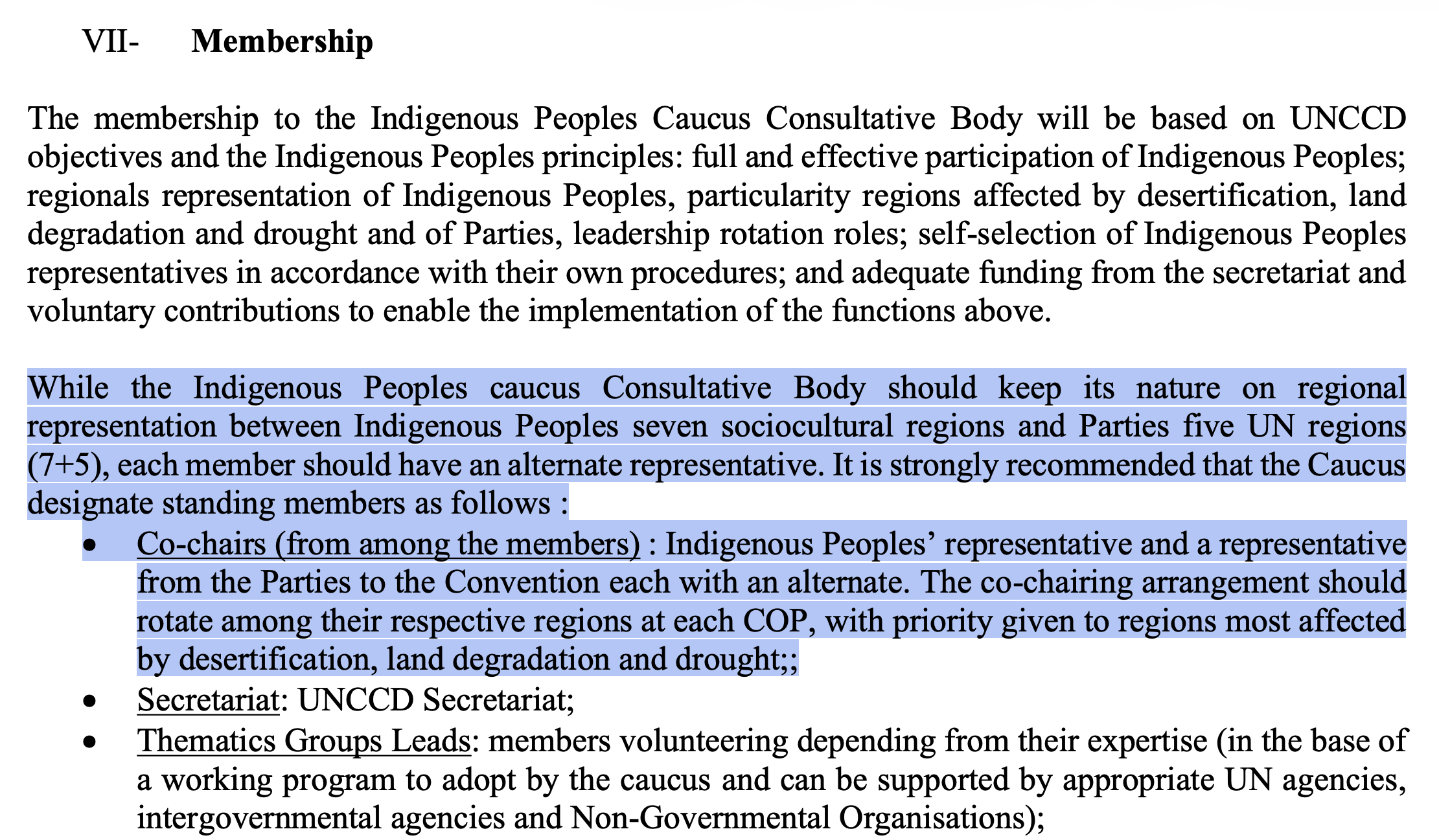
Seven Indigenous regional seats. Five state seats. A state co-chair.
I stopped.
What the UNCCD is and why this matters
There are three Rio Conventions:
UNFCCC is on climate change
CBD is on biodiversity
UNCCD is on desertification, land degradation and drought
The UNCCD covers dry land. 2.5 billion people live on it. Many of them Indigenous Peoples. It’s the convention that gets the least attention in Indigenous circles. That is starting to change.
At its COP16, parties decided to create an Indigenous Peoples Caucus under the UNCCD. Suddenly. Then the Secretariat drafted a Terms of Reference. Now it is open for written comments.
Deadline: June 15.
Nine days.
Wanting a caucus is the right instinct. To see what went wrong, you need to know what a caucus actually is.
What a caucus actually is
A caucus is your locker room. It is where you agree on your position before you walk into the negotiation. Where you decide what to say and what not to say. Where you have the argument before you are in the room with states.
It only works if the other side is not in there.
Your community is deciding what to say to the government. A government official is in the room while you’re deciding. Not as a guest. As a permanent member with a co-chair title.
You would not call that a community meeting.
That is the structure this document built. If you want the full picture on what a caucus should be: The Indigenous Caucus: Your Power Move in UN Spaces
Now read what the Secretariat actually built.
It said caucus. The draft built something else.
At COP16, the decision asked the Secretariat to support the development of terms of reference for an Indigenous Peoples Caucus. That is all it said. It did not:
Create a formal body
Give states seats in the caucus
Mandate a state co-chair
Allow states to review or amend the governance
Give states the power to decide when it takes effect
The document used that mandate the way a planning permission to build a shed gets used to build a house. The permit said caucus. The building says consultative body.
Here is what the draft actually built:
Five permanent state seats inside the body
A state co-chair
State-led review every four years
Entry into effect only when states adopt it
A body designed around state participation got a name that says Indigenous Peoples.
The name is doing specific damage.
It says Indigenous Peoples. The seats say otherwise.
The document is called the Indigenous Peoples Caucus.
An Indigenous caucus TOR that’s under review by Parties? This is a major leap backwards.
That name tells every Indigenous person reading it: this is yours. You are safe here. You can coordinate here.
But the composition gives states five permanent seats and a co-chair. The rules can change every four years when states decide to review them. The document does not exist until states adopt it.
You walk in. Five state representatives already seated. A state official at the front. A note on the door: this room only opens when we decide. That’s a trap with a friendly sign.
Now look at the numbers.
The LCIPP Facilitative Working Group has seven Indigenous regional seats and seven state seats. Parity. Indigenous Peoples fought for that. It took years.
The UNCCD draft uses seven Indigenous seats and five state seats. Not even parity.
Why are they in there at all? The second document makes that question even harder to answer.
The local communities TOR is the cleaner document
There were two TORs drafted. One for Indigenous Peoples. One for local communities. Same Secretariat. Same convention. Same moment.
The local communities document:
Self-organized
Internal
Non-binding
Governance kept to a minimum
The Indigenous Peoples document:
State seats inside it
State co-chair
State-led review
State adoption required
The document with our name on it gives you less than the document without it. That’s the kind of outcome you get by accident or by design. Either way, it’s a problem.
A caucus is where Indigenous Peoples organize themselves. A consultative body includes States. The mandate asked for one. The draft built the other and gave it the first one’s name.
The comment window is still open.
Before you go
Most people read the objectives, feel reassured, and submit nothing. The text moves forward.
Read Section XII and XIII first. XII tells you who controls the review. XIII tells you when it takes effect. If those aren’t in Indigenous hands, the objectives are decoration.
I’ve sent my comments to the IITC team. Submit something before June 15. Three sentences. You need to be on record.
This document won’t stay inside the UNCCD. Other bodies will copy it. Bad examples travel faster than good ones.
Here is the painful part.
Before this document, you had the right to caucus. Nobody gave it to you. Nobody can take it. You show up. You coordinate. That is yours.
After this document, your caucus exists when States adopt it. Meets when they fund it. Changes when they decide.
You are being asked to trade something you already own for something they control.
And most people in the room thought that was a good deal.
See you next Saturday.
P.S.
I answer 5 questions for Indigenous leaders that don’t want to just show up to the UN:
What’s the map I’ve been missing? Weekly newsletter
I have a situation. What do I do with it? Open AMA
What’s my next move in this process? Playbooks
What’s your read from inside right now? Daily briefs
How do I actually win in today’s UN? Workshops
I built all of this because showing up has never been enough.