
The three-part system I never wrote down
On building a method out of 20 years of getting it wrong first.
Tabea, happy Saturday/Sunday,
Sorry, with a flight a couple of hours away, I accidentally scheduled this newsletter to be sent out next Saturday not THIS Saturday. Again, sorry for the delay.
Anyway, what I wanted to talk about today is.
Awareness, and if that's enough. If not, what else should you do?
A great speech, a standing ovation, someone screen recording your statement off UN Web TV and posting it to Facebook, all of that raises awareness and gets your voice heard, but none of it actually moves anything. The only real measurement of progress is whether the text actually changed.
I have watched this pattern for two decades.
Handshakes, warm eye contact, someone telling you that you have an ally in them, and then when the actual moment comes, nowhere to be seen. Stakeholder maps, strategy documents, procrastination dressed up in a suit. I got sick of walking out of rooms with a stack of beautiful documents and nothing to show for it, so I built myself a system.
I call it Power GPS.
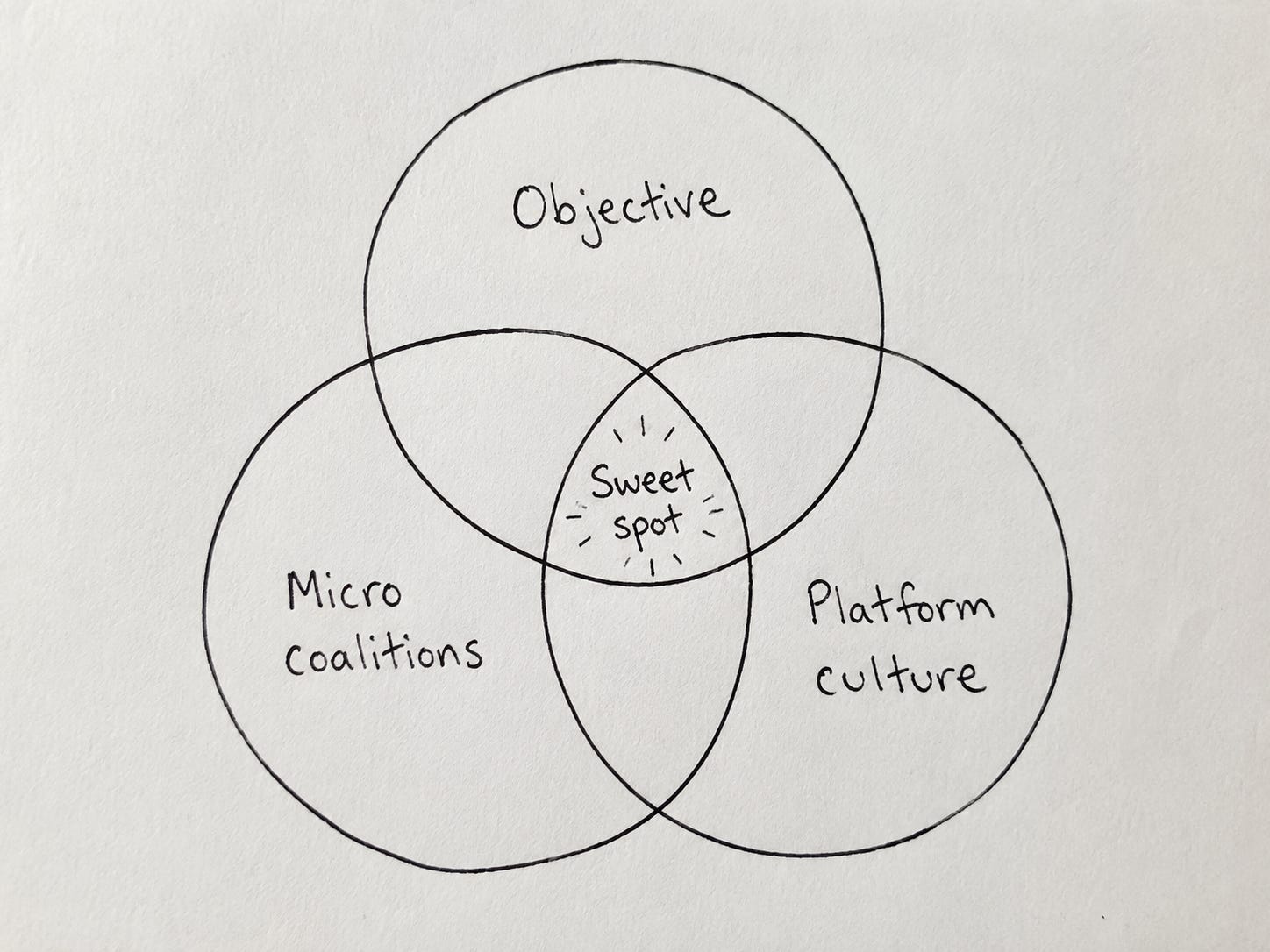
Three satellites, one triangulation
Satellite one is your objective, and I mean a destination, not a direction.
“We want more participation” is a direction. You cannot measure arrival at a direction, so missing it teaches you nothing. A destination is a specific clause, a specific seat, a line in a named text, something you can actually clock arrival at.
If you miss it, that is fine, because now you have data on how far you got and why.
Satellite two is micro coalitions, and this is the one people get wrong most often. It runs much more granular than “let’s get Canada on board” or “let’s get the EU.”
I keep a Notion doc with fifty of these mapped out.
Gulf Cooperation Council progressive members. Countries with strong Indigenous movements. Environmental pioneer countries like Bhutan, Costa Rica, Denmark. West African coastal states. Every one is a hypothesis you test. Some work and you keep them. Some do not and you retract them, like an accordion, built around interest rather than geography.
Satellite three is platform culture, knowing the actual room you are in.
The Human Rights Council is a different animal from the General Assembly, which is a different animal from BBNJ, which is a different animal from a CBD COP, even when one is technically subsidiary to another. Every platform has its own protocol, its own unwritten rules about who speaks first, who needs a private word before they will say yes in public.
You do not get handed these rules. You reverse engineer them by watching, every single time, before you ever open your mouth.
Where all three satellites overlap is your sweet spot.
If your goal is three references to Indigenous Peoples in an adequate housing resolution, and your coalition is Panama, Bolivia, and Colombia, and you know how the Human Rights Council handles that resolution, that triangle is where your message gets pinpointed instead of sprayed everywhere and hoped for.
Then comes the part almost nobody actually does.
Four questions, after every intervention, every bilateral, every vote.
What was supposed to happen. What actually happened. Why the gap. What did I learn. I picked this up from a military documentary about an air force unit, where the officer said the debrief matters more than the mission itself, no ranks in the room, because that is the only way people actually improve for next time.
The four questions cost me about ten minutes a day. They have probably saved me years.
I call the whole approach spray and pray, but with strategy. And I want to be precise about what that means, because it is not the same as throwing spaghetti at the wall, like spraying one message everywhere and hoping.
The old playbook was a single one pager, carpet bombing the entire city of Geneva with the same line, because there are so many delegations living in that city that one message never lands the same way twice.
The new version is still wide.
You are still putting things out into a lot of rooms. But each version is tailored to the specific micro coalition receiving it, 10 or 15 different packages carrying the same core position, instead of one generic package sent to everyone and forgotten.
The volume side of the system shows up here.
In a single Bonn inter-sessional I once scheduled 22 bilateral meetings, 40 minutes each, because good luck getting a real bilateral inside COP itself. Every one of those meetings fed straight back into the four questions and into the coalition map. It looks tidy on a page.
It runs on a lot of unglamorous volume underneath.
Before you go
The usual roadblock here is that people try to stand up all three satellites at once, decide the whole thing is too elaborate for the time they have, and quietly go back to working on instinct.
Build one.
Take your next intervention and write down the destination only, a clause, a seat, a line you could point at afterwards and say we got that or we did not. Leave the coalition map and the platform reading for later. One satellite used properly will outperform three you abandoned in week two.
I built this out of post-it notes on a wall long before I owned an iPad, trying to find the pattern underneath years of BBNJ and World Conference negotiations.
I do not do well with rigid scripts, so think of this as Minecraft, not Tetris.
I am handing you the raw materials, three satellites and four questions, so you can build whatever the room in front of you actually requires.
20 years, same system.
Go build your own version of it.
See you next week.
P.S: Check it out, the Substack is now (also) organized by process: BBNJ, Article 6, UN80. Now, you can follow one stream without being drowned in everything. Let me know what you think!
P.P.S:
