
The questions I ask before every UN intervention.
On what actually moves a decision at the UN.
Tabea, happy Saturday,
So……I have a weird confession to make.
I can get very interested in procedural rules.
I can completely nerd out on Rules of Procedure.
Not because procedure is beautiful. Most of the time, it is not. It is dry, slow, full of acronyms and sentences that sound like they were written by someone who lost a bet.
But procedure tells me something important. It tells you how power actually moves.
A special session doesn’t always happen
This week, I was following a Human Rights Council discussion on special sessions. What struck me is that they don’t happen simply because something terrible is happening in the world.
Iran, Palestine, just to name a few.
A crisis can be real, the evidence clear, and still the Council does not move on its own.
There is a mechanism. A member has to initiate the request. Then a third of the 47 members have to support it. 16 states. One moves first. 15 follow.
Then the machinery turns on.
Most people miss this part, because they experience the UN through the visible moments: the speech, the vote, the final text. So they assume the work is the statement.
Why the statement matters anyway
I get why.
Especially for Indigenous Peoples, statements are not just technical documents. They carry memory, grief, land, ancestors. They carry the frustration of explaining, again, that we are Peoples, not stakeholders, not communities to be managed.
Statements matter. A good one protects a record and makes it harder for a process to pretend we were silent.
But, a statement is not always the work. By the time you write it, the real work has often already happened somewhere else. The work is figuring out where and when the decision becomes a decision.
The questions nobody asks
Once you understand that, you stop looking only at the final session. You start asking what happened before it.
Who asked for the meeting?
Who is in the informal, and who is outside it?
Who has the pen?
Who needs political cover before they will say yes in public?
That last question matters most, because every process has a moment when a decision is still soft. Before the text hardens. Before a chair says, “I sense there is no appetite to reopen this paragraph.”
That is the window.
Sometimes it is a corridor, a WhatsApp message, someone saying “send me the language.” By the time the formal meeting begins, the window is often half closed.
The statement is one tool. Mistake it for the whole strategy, and you keep arriving at the station after the train has left.
The furniture trap
Imagine this. A draft comes out.
Indigenous Peoples are missing, or folded into “Indigenous Peoples and local communities” as if that costs nothing. FPIC gets softened into consultation. You try to mobilize people, you scramble: strong interventions, circulated language, reports of the Special Rapporteur, or the joint-statement of the 3 UN mechanisms working on Indigenous rights.
Necessary. But also, late.
Like fixing your house’s foundations after the roof is on. We are asked for comments on the furniture. But the house has already been built.
This is why I think the biggest shift Indigenous advocacy needs is moving from statement advocacy to architecture advocacy.
Statement advocacy asks, “What do we need to say?”
Architecture advocacy asks, “Where does this decision actually get shaped?”
Different question, different behavior.
The second moves attention upstream: is there a zero draft, and who writes it? Which states are nervous, and which agree with us but need language they can defend?
This is unglamorous work. It rarely gets quoted, and it decides whether the quote matters.
What influence actually looks like
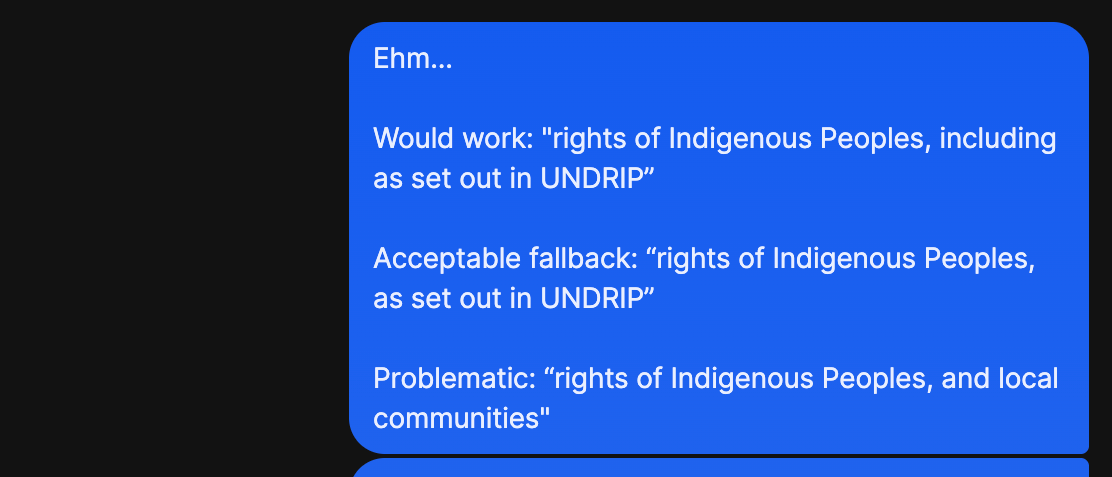
More often than not, influence looks boring. Sending a paragraph at 11:42 p.m. Giving a delegation three options: Ideal language, acceptable language, minimum red line.
A perfect paragraph nobody can carry is not a strategy. It is a document. A delegate may agree with you but have no instructions. A friendly state may like your language but fear reopening a paragraph.
Advocacy is about making the right thing movable. Being right alone doesn’t cut it.
Sometimes states act in bad faith. But sometimes the problem is simpler and more frustrating. The right language arrived too late. The wrong person received it. The process had already moved on.
So get better at reading the room before it becomes visible.
Present, but not positioned
Our participation is often treated as a symbolic add-on: present, but not positioned, heard but not able to shape. Registration categories, speaking order, access to informals: these look procedural. They are political.
The next phase of Indigenous advocacy should be about better positioning: engaging before the text is fully formed, building relationships before we need them, and preparing language others can use.
That is why this work is hard to teach. Timing matters as much as law. Judgment matters as much as principle.
Once you stop seeing the UN as one big room and start seeing it as a set of moving parts, you stop feeling like everything depends on one speech. A meeting that looks boring may be the place where the future text is being prepared.
Call it agency, not cynicism.
Before you go
The lesson is simpler than “the system is bad” or “statements are pointless.” Do not mistake the visible part of the work for the whole work.
Before the next statement, ask different questions.
Is the text still movable? What do the people who can move it need from us: exact language, political cover, a red line?
It’s about making the ask travel. A right that cannot travel through the process remains a right on paper. Indigenous Peoples have had enough of those.
The work is everything that makes the statement land: the relationship that gets it read, the timing that makes it useful, the language that makes it carryable. I want us to be earlier. Better positioned. Understanding the machinery well enough to use it, challenge it, and redesign it when necessary.
Say the right thing. Then get it into the place where decisions are still possible.
That’s it for this week.
See you next Saturday.