
How one bad phrase can break UNDRIP
On how bad language spreads inside the UN.
Tabea, happy Saturday,
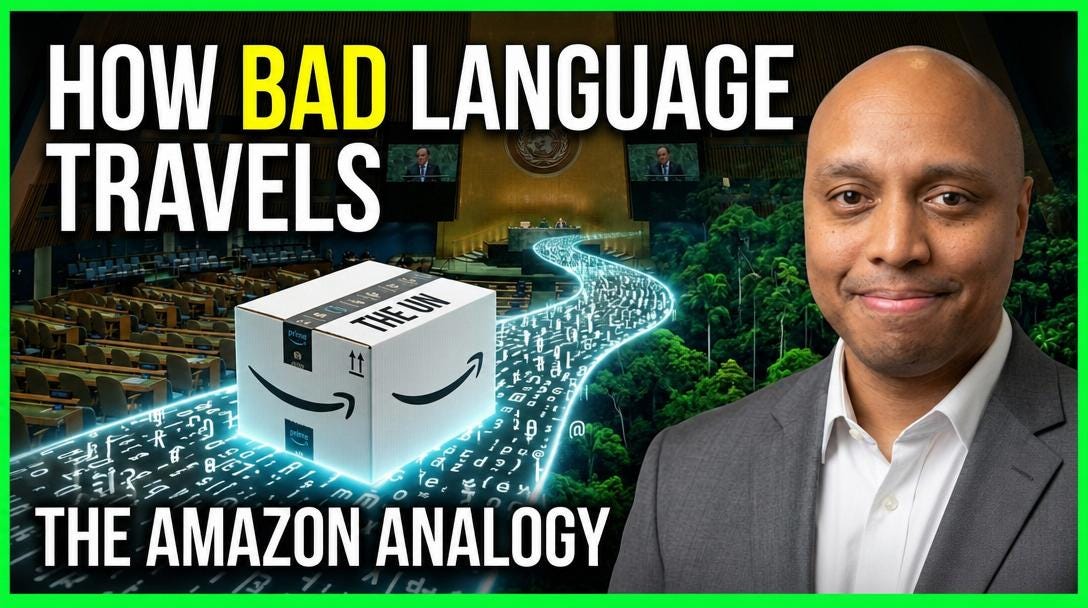
Let me explain how bad language travels through the UN using Amazon.
But first, let me tell you what I said last week at the FWG plenary in Bonn.
I told the room that bad language travels.
Not accidentally.
Not through sloppy drafting.
Through a deliberate strategy called forum shopping.
Parties find the point of entry with the lowest friction. They insert bad language there. Then they duplicate it across other processes.
That is the game.
And the reason I raised it in that plenary, specifically around the ethics protocol, is this:
If you allow bad language into one document, you have handed someone a template.
Now let me explain how that template moves. Using Amazon.
Now, here’s something Amazon understood before anyone else did.
The problem with delivery isn’t the last mile. Everyone obsesses over the last mile. The van. The doorstep. The signature. But the last mile is fine. The last mile is visible. The last mile has a tracking number.
The problem is the warehouse at two in the morning.
When someone who has never met you, has never heard of you, and frankly couldn’t pick you out of a lineup, decides what goes inside your package.
You ordered something. It packed itself. Twelve people handled it. None of them knew what it was supposed to contain. It arrived at your door anyway.
This, it turns out, is also how international law works.
Amazon delivers packages in two days. The UN delivers language in two years. Both carry items you did not order. Both are packed by people you have never met. Both arrive whether you are ready or not. And both, if you are not paying attention, will contain something deeply, structurally wrong that looks completely fine from the outside.
The genius of bad language, and I use the word genius advisedly, because it takes real skill to do this badly in such a consistent way, is that it never arrives labeled as such.
It travels in the same font as good language.
It passes through the same processes.
Nobody at the distribution center checks whether a word is dangerous. There is no scanner for that. There is no little sticker that says “Warning: this phrase replaces a binding obligation with an aspiration.”
Collective consent becomes individual comfort. Peoples’ rights become group interests. The right to Free, Prior and Informed Consent becomes administratively cleared.
The words stay. The protection disappears.
What you receive looks like what you ordered. It is the same size. It is wrapped the same way. It has all the right labels on the outside.
It is just quietly, methodically, and entirely the wrong thing.
The job is not to negotiate. It is to intercept.
Everyone assumes the job is to negotiate.
It is not.
Negotiation is the last ten percent. The other ninety is this: Making sure that what arrives at your door has not been repackaged in transit.
Most people wait at the door.
I work the warehouse.
What bad language is and why it is hard to spot
Bad language is not a typo. It is not clumsy writing.
Bad language is language that sets you back. It arrives looking useful. Sometimes it looks like progress. But it replaces something stronger with something weaker. It lands in your process and you do not notice until it is already working against you.
The genius of bad language is that it never arrives labeled as such. It travels in the same font as good language. It passes through the same processes. Nobody at the distribution center checks whether a word is dangerous. There is no scanner for that.
3 live flight risks: LCIPP, UNCCD, and the FWG
First. The LCIPP ethics protocol. Inside the June 2026 draft, one annex replaced collective FPIC with a signature line. One knowledge holder signs that they are comfortable. The community has no say. The knowledge travels globally.
That is the legal equivalent of replacing the lock on your front door with a Post-it note that says please knock.
Any other body can now copy this protocol, strip the FPIC language, and add the logo. A state or a company says: We did not do FPIC, but we followed the ethics protocol. Less binding. More vague. A loophole with a UN address.
Second. The UNCCD caucus. A COP16 decision built a framework for indigenous participation under the Convention on Desertification. The legal foundation it used was a 2017 General Assembly resolution written for a completely different process. Wrong instrument. Wrong context.
The terms of reference that followed turned a coordination caucus into a constituted body. Seats. Governance structures. Review cycles. When you cannot fill the seats, the review reduces them.
You did not design this. You inherited it.
Third. Three words that looked like a win. one Party added the phrase in its entirety to a UNDRIP clause at the very last moment of FWG operationalization. The eleventh hour. Everyone was tired and relieved.
The room celebrated. More of UNDRIP recognized, they said.
I was lead negotiator. My legal mind went straight to the problem.
Here is what not many people know. Every UN Declaration can be applied selectively. You cite the article that serves your argument. You build your position around it. The rest stays on the shelf.
That selectivity is not a bug. It is a feature. It is how you corner a state on article 32 without them being able to retreat into the parts of the Declaration they find uncomfortable.
But in its entirety changes that completely.
Once UNDRIP comes as a package, you have handed every resistant state a way out. They no longer need to engage with the specific article that inconveniences them. They can reject the whole instrument instead.
More than that. In its entirety quietly places UNDRIP below other UN Declarations that do not carry that phrase. Those instruments remain selectively applicable. Flexible. Negotiable article by article.
UNDRIP becomes the rigid one. The all-or-nothing instrument. In a system where States prefer to engage selectively, all-or-nothing is a reason not to engage at all.
Three words built a hierarchy amongst UN Declarations without anyone voting for one.
The eleventh hour is not when states add gifts. It is when they add things they hope nobody reads carefully.
Who introduced it matters. When they introduced it matters.
If you weren’t in the room you wouldn’t catch it.
How the UN copy-pastes language
The most important moment is not when the package arrives. It is when the box is packed.
The UN calls dangerous items best practices. A body needs to build something. It finds a text it likes. It copies it, rinses it, adds the logo. Done.
The World Urban Forum has almost no indigenous people inside it. But it sees a protocol, a framework, and copies it. It does not read the backstory.
Bad language ships fast because bad language ships light. No safeguards attached. No negotiating history. No context.
Good language is heavier. It carries all of that. That is why it moves slower.
Why I sit in 60 UN resolution negotiations a year
I sit in over sixty resolution negotiations a year. Not because my mandate covers all of them.
Because that is where the box gets packed.
Climate. Poverty. Business and human rights. Sea level rise. Oceans. Rooms where the word Indigenous never appears. That is exactly where the dangerous items get added. In a room that did not say your name, in a document that never mentioned you.
My job is not to receive the package. My job is to be at the warehouse before it ships.
If you remember nothing else
Bad language does not look bad. It arrives in good packaging.
The dangerous item gets in before the package leaves, not after it arrives.
Sixty rooms a year is not about presence. It is about interception.
Before you go
Here is the mistake most people make. They track their document. They find their language still there. They think the week went fine.
They miss the rooms where language heading toward them was already packed.
Before the next session: check what is being drafted in rooms without your name. Ask what words replaced what.
What is being packed into your process right now while you are not in the warehouse?
See you next Saturday.
P.S.
I answer 5 questions for Indigenous leaders that don’t want to just show up to the UN:
What’s the map I’ve been missing? Weekly newsletter
I have a situation. What do I do with it? Open AMA
What’s my next move in this process? Playbooks
What’s your read from inside right now? Daily briefs
How do I actually win in today’s UN? Workshops
I built all of this because showing up has never been enough.