
Article 18 doesn’t say what you think it says.
On the blind side of international law
Tabea, happy Saturday,
It’s Wednesday evening in Geneva, heatwave of 30+ degrees just started.
I’m walking back from a negotiation that had nothing to do with Indigenous Peoples.
At least, that’s what the agenda said.
It was on the draft Declaration on the Rights of People of African Descent. Not my process. My name wasn’t on the programme. Nobody sent me an invitation.
I was there anyway.
As this process has something.
Paragraphs lifted verbatim from UNDRIP articles buried deep inside the African descent draft. Collective rights. Ancestral lands. 30 years of the Indigenous movement’s language, now being applied to a different group, on the same lands, without a single separation clause.
Here’s what that costs you.
In Latin-America, communities of African descent (so those from the transatlantic slave trade) and Indigenous Peoples are already claiming the same lands under different legal frameworks. When that tension reaches international level, and it will, States will point to this text. They’ll say both claims are covered by the same standard.
Your distinct right to FPIC? Just got averaged down.
I’ll say it again: Your distinct right to FPIC get averaged down.
Let me make it real practical for you here.
Imagine you live on a river basin in Colombia. Your community has been here for four hundred years. You know every bend in that river. Your entire lineage is buried there too.
One morning, a community of African descent next door files a legal claim on a piece of your community’s lands. Ancestral lands, they say. Their ancestors were brought here. They have roots there too. Where? Exactly that piece of land where your grandparents were buried.
And now they have a declaration that says those roots are protected under international law.
Same word as yours: Ancestral.
Same rights as yours: Collective.
You both show up to the same table. You both have documents. You both have history.
Now what?
There is no clause in either text that says whose claim takes priority. No mechanism that resolves the overlap. States do not need to take your land. They just step back and let the two claims cancel each other out. While you fight, the dam gets approved.
That is what is sitting inside that draft. 30 years of your movement’s language, copied word for word, applied to a different group, in the same geography. No separation clause. Nobody flagged it.
I did.
Reparations has not even arrived yet. When it does, this gets worse.
You cannot stop a waterfall with a sippy cup. You go in before the waterfall forms.
Moral of the story is that you belong in every negotiation where your rights could be touched. Even when its not on their or your agenda. I call it The Blind Side. Find it before it bites you in the ass.
Pardon my French.
But knowing the trap isn’t enough.
You still have to decide what to do when you’re in the room.
The silence I chose
Here’s what happened this week: Business and Human Rights treaty.
In short, States are writing a binding treaty on corporations and human rights. Not a guideline. A treaty. When a mining company destroys your land, this is the text that decides what happens next. Who is a victim. Who gets a remedy. Who gets nothing.
One morning we were debating who counts as a “victim” under the instrument.
Individuals? Groups? Collectives?
I had a statement ready.
But I didn’t take the floor.
Here’s why.
I could see some States waiting. The ones that have blocked UNDRIP language in six consecutive sessions. The second I would say in my speech that “Indigenous Peoples” need to be inside the victims definition, they would have added “and local communities” to the same clause.
I was also calculating that since we were discussing definitions in Article 1, that it could open the door to a definition of Indigenous Peoples. Huuuuge no go.
The definition then becomes “individuals, groups, Indigenous Peoples and local communities.” Now we’re in a deconflation fight inside a legally binding instrument. The session burns on that. We would leave with less than we arrived with.
What to do?
I texted a colleague instead.
What if you proposed “individually as well as collectively”?
That would cover communities, groups and us, without naming Indigenous Peoples explicitly. Its an elegant way out, in stead of only singling out individuals. But more importantly, nothing for some delegations to hook local communities to.
She proposed it. It landed. A State and NGOs echoed the proposal. Colleague looked smart. Pandora’s box stayed shut. Everyone wins.
Before you speak, ask yourself one thing: Does saying something put a target on the idea?
Sometimes your name, or the deliverer is the problem. Not the argument. Just you.
So you do not say something, you text a colleague, you give them the language, they put it in the room. Same ask. No target on your back.
But none of this works if you don’t know what the UN Declaration already gave you.
Most go to the UN wearing a straightjacket. They forget something important in the UN Declaration. They wait for the pain, harm, violation to be visible before they claim the seat.
That’s too late.
What article 18 actually says
Another one.
Last year I received a message from an Indigenous leader in another process asking if I could review a communication to the UN, it was about participation.
I read the doc: Good instincts. Wrong framing.
The letter said that Indigenous Peoples have the right to participate in environmental decision-making processes that affect them.
I’ve heard that in interventions. Read it in submissions. Seen it in letters sent to actual treaty bodies.
Everyone says it.
But, Article 18 doesn’t.
Article 18 says that you have the right to participate in decision making. All of them. Not just environmental ones.
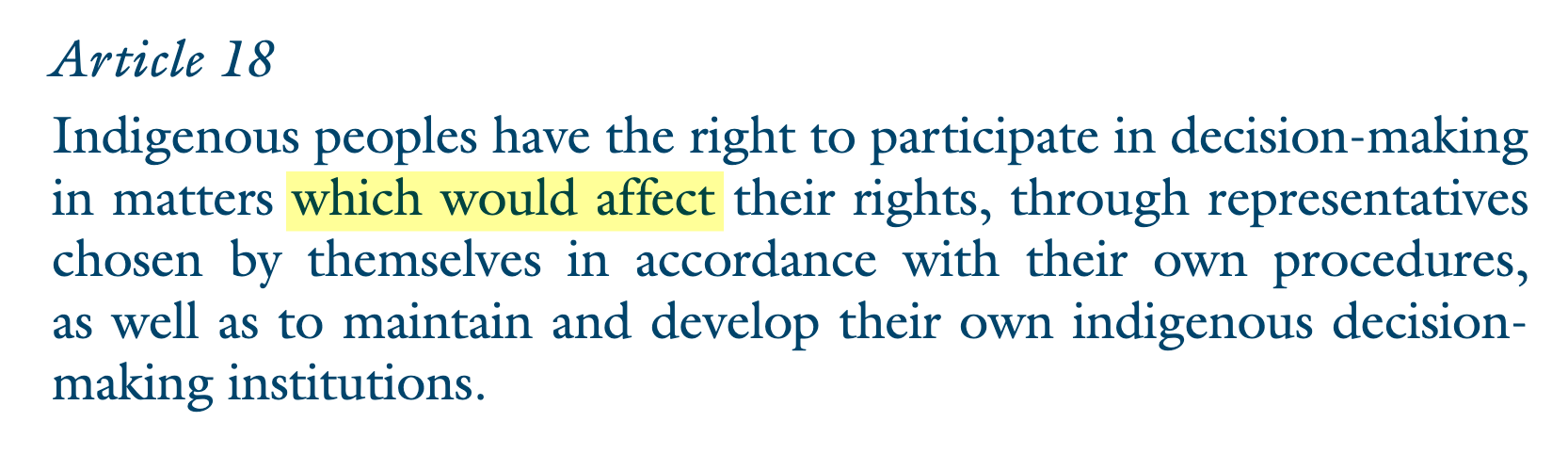
Article 18 also says the right is to participate in decision-making in matters which would affect…
the operative word being: Would.
Here’s how you should read it:
You don’t need to prove that a process is already harming your Indigenous Peoples. You only need to know (not show) that it could affect you. That’s the difference between waiting for the damage and preventing it.
I’m talking: Outer space governance. AI policy. Ocean, business, drugs, tax, older persons, anything under the sun treaties. So not only wherever the word Indigenous appears but also where it may never appear or never appears.
If you decide that something may affect your Indigenous Peoples’ rights, you already have a seat. Mazel tov, now go get ‘em.
Don’t take my word for it, the UN said so.
It isn’t a process but a meeting or something else?
That’s why the word MATTERS is important.
This is why I was in that African descent session. Why I sit in over 60 resolution negotiations a year, adequate housing negotiations, sea level rise consultations, right to development meetings. None of them say Indigenous. But all of them fall under would affect.
The UN isn’t like that movie Minority Report. That Tom Cruise film where police arrest people before the crime even happens. That system acts before the damage.
The UN doesn’t work that way. It doesn’t detect the absence of Binota, Pirita or Huna and calls them in. It doesn’t act before the damage happens. It doesn’t wait. But it does react. It moves when you push and does nothing when you don’t.
Nobody is coming to get you.
So, what do you do? You go. Show up before the word ‘Indigenous’ appears, claim that seat. Get in their face (in a diplomatic way).
Many of you have been waiting for a system that acts proactively, but that system doesn’t exist.
Stop waiting.
If you remember nothing else:
The Blind Side is where the structural damage happens. Scan for it before the session opens.
When your name creates a hook, let someone else carry the text. You get the result without the fight.
Article 18 says “which would affect.” That word expands your mandate into every UN process. Use it.
Before you go
Now, here’s a common mistake.
Next week (maybe at SB64 in Bonn) you’ll check that document, Command+F “Indigenous” find that it’s still there, and think the week went fine.
You’ll be right about that document.
But, you’ll miss the four other texts that moved language you didn’t see coming.
So, list every process touching land, climate, finance, health, oceans, or business. That’s your watch-list. You don’t have to fight all of it. Just stop going blind.
That’s it for today, enjoy your weekend.
See you next Saturday.
P.S.
I answer 5 questions for Indigenous leaders that don’t want to just show up to the UN:
What’s the map I’ve been missing? Weekly newsletter
I have a situation. What do I do with it? Open AMA
What’s my next move in this process? Playbooks
What’s your read from inside right now? Daily briefs
How do I actually win in today’s UN? Workshops
I built all of this because showing up has never been enough.