
How to Reject the 'Observer' Mindset (Even If You're Wearing the Badge)
COP30 day 23 of 30: Why your yellow badge is convenience, not your political reality.
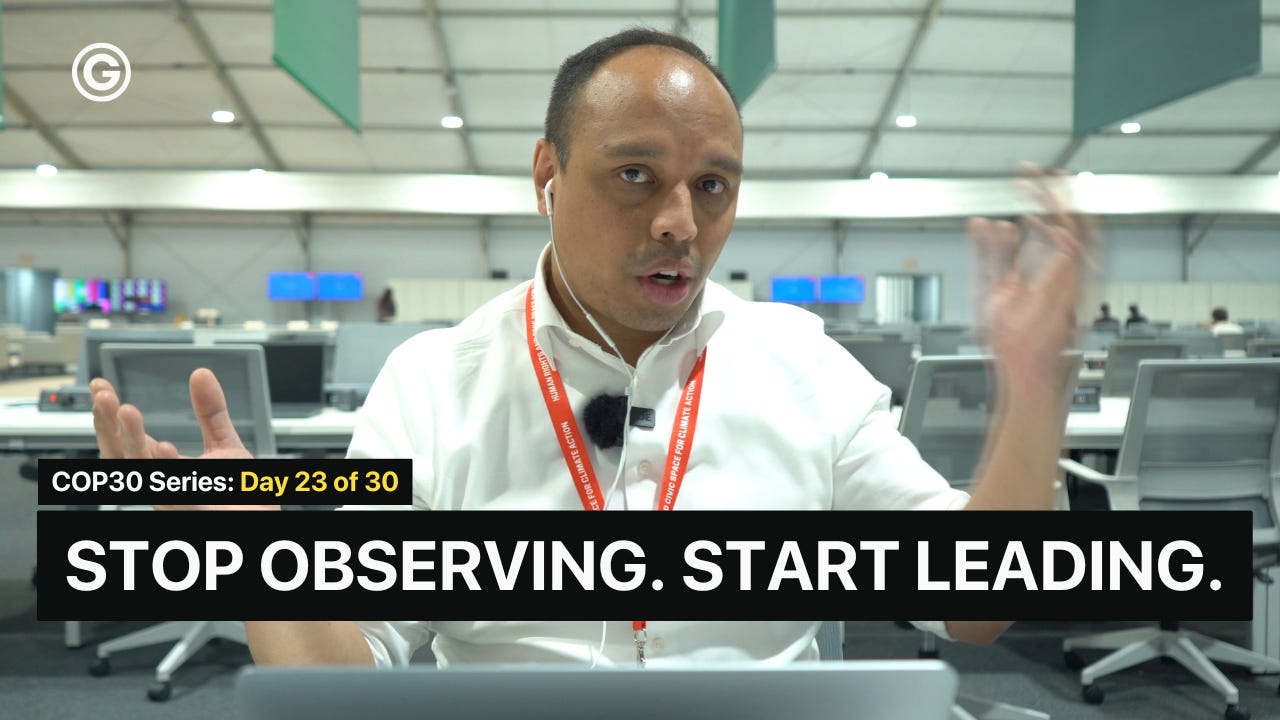
Welcome to day 23 of your 30-Day Series!
In this series, we’re building from LCIPP mechanics through Indigenous participation frameworks to COP negotiating tactics. By day 30, you’ll understand how Indigenous Peoples move from values to operative text at the world’s largest climate negotiations. Today we’re talking about why your official designation is a trap and how to maintain your true status.
On your first day, you will get your badge. Most likely, it will be a yellow “observer” one.
You will be in the same category as the other eight “constituencies” or Environmental NGOs (ENGO), Business (BINGOs), Youth (YOUNGOs), and so on.
This is the first and most subtle trap you will face. It is a bureaucratic convenience for the UN system, but it is not your political reality.
Many new Indigenous representatives make the mistake of accepting this label as is. They don’t forget who they are, but adopt the mindset of a “civil society” group. I’m here to prevent you from making this critical error.
You Are Not an “Observer”
You must maintain one mindset at all times: You are not just another “civil-society participant”.
THEY: CSOs and other NGOs are advocacy groups. They ask Parties to act, based on morals or policy.
YOU: You are a representative of Peoples. You are a distinct rights holder under international law (like the UN Declaration on the Rights of Indigenous Peoples).
Your Indigenous rights are not just as individuals. We also hold collective rights, including the right to self-determination and the right to participate in decision-making on issues that affect your Indigenous Peoples.
This is not just a “moral” argument. It is a legal and political one. CSOs “advocate” for a seat at the table. You have a right to be there. This distinction has to change every intervention you make.
When You Must “Push Back”
This mindset will be tested in a very specific scenario. Here is the play-by-play of one I experienced at many Article 6.4 Supervisory Body meetings.
It is late on the final day, the meeting is pressed for time. The Chair is trying to rush. The Secretariat sends an email to all the observers saying:
“We only have time for one observer statement. Can all the observer constituencies please coordinate a single, joint statement?”
This is the trap.
My job was to push back, and so I did.
“Thank you, we are sympathetic to our colleagues in civil society and the other constituencies. However, Indigenous Peoples are not in the same category. As distinct rights holders under international law, we must insist on delivering our own statement.”
Why You Must Never Accept a Joint Statement
This is not about being difficult. It is about defending Indigenous Peoples’ political status for the entire negotiation.
The moment you agree to a joint statement, you have agreed to be “in the same category” as CSOs. You have just weakened your unique political status in front of the entire room.
Your sharp, rights-based points will be watered down into a vague, “lowest common denominator” statement that pleases everyone and influences no one.
You can be (and should be) allies with CSOs. But being an ally is not the same as being the same. You must always maintain this distinction.
Before You Go
Do not let a plastic badge redefine your political identity. Your badge is what the UN gives you, but your status as a distinct rights holder is what you bring. You must defend that status at all times, especially when it is inconvenient.
Tomorrow, I will explain “How to Work with a Facilitator”, the most important person in any negotiation.
See you then!
P.S.: When in your life have you had to remind someone of who you are vs. what they think you are?