
Why Your Win Can Disappear in the Final Hour
COP30 day 21 of 30: Why Indigenous Peoples' Rights is always at risk
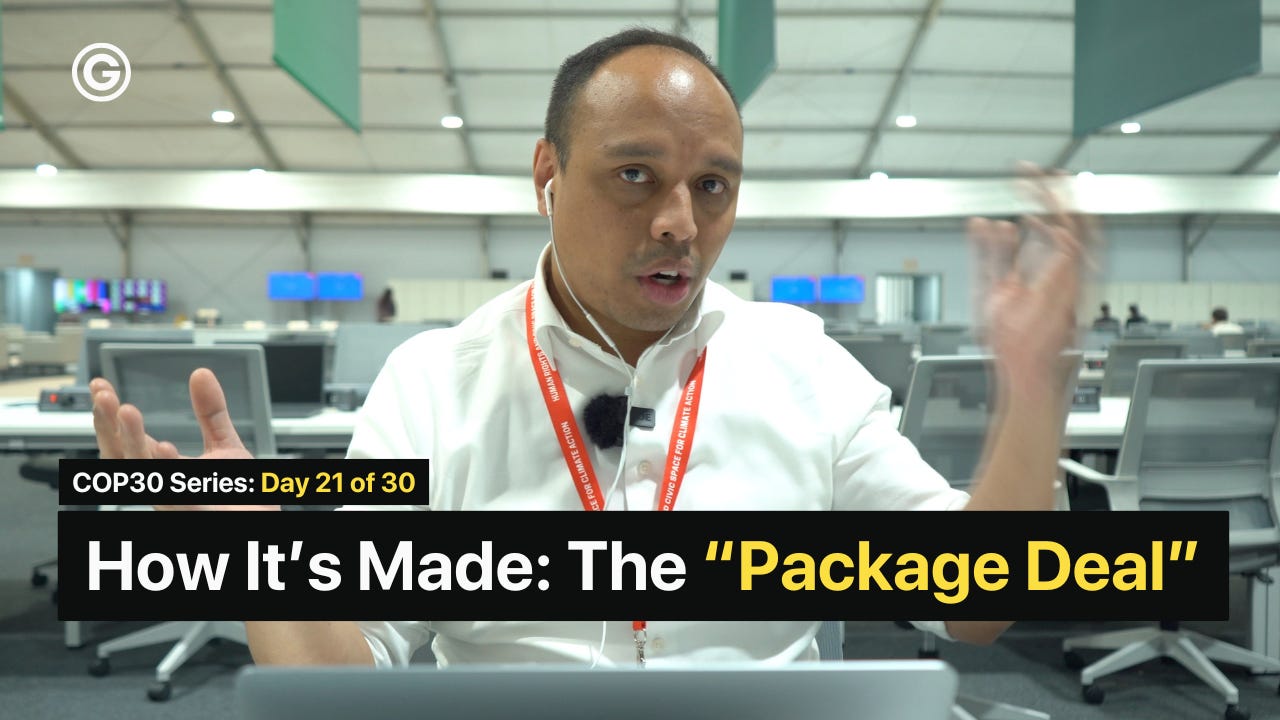
Welcome to day 21 of your 30-Day Series
In this series we’re building from LCIPP mechanics through Indigenous participation frameworks to COP negotiating tactics. By day 30, you’ll understand how Indigenous Peoples move from values to operative text at the worl’s largest climate negotiations. Today we’re talking about the final, high-stakes “Package Deal” and how to stop your issue from being traded away.
It is the final 48 hours of COP. You are exhausted.
The “ministerial consultations” on Indigenous rights have finished. You fought hard, and you have a text you can live with.
You think your issue is “secured” You think you’ve won.
But it is not “official.” Why? Because your decision is not adopted by itself. In the final days, the Parties will weave your issue together with all the other major decisions (on finance, adaptation, mitigation, etc.) into one single “package.”
This is the most dangerous moment of the entire conference. Your “secured” issue is now a bargaining chip.
What Is the Balanced “Package”?
This “package” is the Parties’ endgame. Here is how it works.
Why a “Package”? The entire process runs on consensus. This means no Party will agree to its “loss” (e.g., accepting stronger mitigation text) until it sees its “win” (e.g., getting more money for the loss and damage fund). The “package” is the only way to show all 190+ countries their “wins” and “losses” at the same time.
The President Takes Control: The Presidency ends the ministerial consultations and takes the remaining elements of work directly in its own hands.
They Hold Private “Bilaterals”: The Presidency will hold non-stop, private “bilateral” meetings with all negotiating groups. Their goal is to build their understanding of what outcomes may be possible (outcomes ≠ solutions) and hear everyone’s final, non-negotiable red lines.
They Release the “Presidency Text”: Based on these secret talks, the President releases a new draft of everything “under their own authority.” This is the first time you will see all the trade-offs in one place.
The Great Trade-Off
From this moment, your issue is no longer being judged on its own merits. It is now a bargaining chip in a much larger game. Its value is decided by how it balances the entire package.
Parties will often want to see all the draft decisions all together before taking an overall position.
This is where the games of trading happens.
A developing country might agree to Indigenous rights in the text, but only if a developed country agrees to a “win” on loss and damage.
Or, even worse, your strongest ally might be forced to sacrifice your hard-won Indigenous rights text to get something they need for their own domestic agenda (like finance or adaptation support).
In the final package, your issue is not judged on its own. It is judged by how it “balances” the interests of all 190+ countries.
The Dangers of the Package
The “Equally Unhappy” Goal: The Presidency is not trying to make you happy. They are trying to strike a balance where everyone is “equally unhappy” and no one feels they are left with no one to dance with at the final ball.
The “Take It or Leave It” Moment: The Presidency will never say out loud “take it or leave it,” but the final package is in a way that it intends to say. After all, everyone wants to go home.
The “Neglected” Party: The biggest risk to the Presidency is that a Party feels ignored, neglected or forgotten. If they have not been “heard” by the President in those final private meetings, they are more likely to object in the closing plenary.
Unfortunately for Indigenous Peoples, I have yet to see a Party that said Indigenous rights is an absolute most, and a red line. That’s why we must always reframe Indigenous rights so that our allies tell the President the package is “unbalanced” without Indigenous rights.
Before You Go
You must make Indigenous rights is essential to the “balance.” Your allies must convince the President, in those private meetings, that the whole package will fail if it is missing.
The package is on the table. Parties are in the final plenary. The President is about to gavel the decision. What can still go wrong?
I’ll see you tomorrow, where I will explain the drama of the “Final Plenary,” and what to do when a single Party objects and threatens to bring the whole deal crashing down.
P.S.: Please consider sending this to anyone that’s going to COP30.
P.P.S.: 🚀 Read the entire series here.