
UN80: What the negotiations map looks like.
A quick overview of the landscape.
The UN is running efficiency reviews right now. Cutting costs, merging meetings, retiring mandates. It sounds like normal administrative work. That framing is exactly why it is dangerous. When bureaucracies streamline, dedicated spaces quietly disappear, and bodies like the Permanent Forum or the Expert Mechanism get folded into generic human rights processes where nobody is watching specifically for us.
On Thursday the UN80 Initiative co-faciltators held informal consultations, I watched it right after my negotiations in Geneva, and they confirmed what we already suspected.
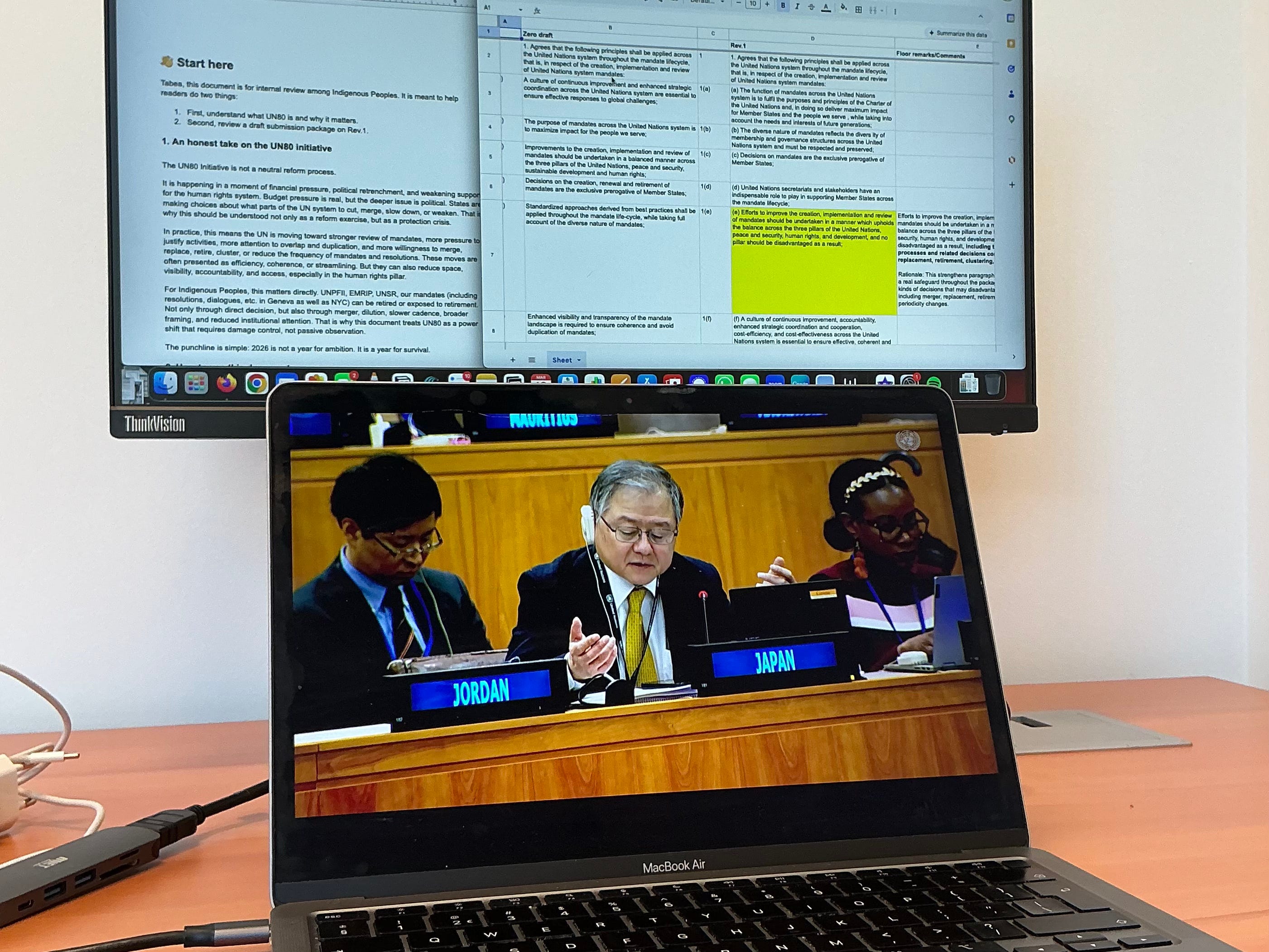
Big picture.
The room is split. Every delegation is asking for some version of the same thing: reform that works without becoming a political free-for-all. But they disagree sharply on how much risk to take. Here is where each country stands and what they actually need.
Camp 1.
I would call this the efficiency bloc. These are the countries pushing hardest for reform. Their goal is to cut what they see as a bloated, duplicative mandate system. Their goal is to cut what they see as a bloated, duplicative mandate system. They want mandatory review cycles, criteria for retiring mandates, and a strong follow-on Working Group to drive the process.
EU
Champions clustering mandate implementation reviews to reduce fragmentation
Wants fixed review cycles, especially for mandates with no existing review mechanism
Supports a time-bound Working Group
Emphasizes review should cover both new and existing mandates as part of the mandate lifecycle
Australia
Backs OP21 for reviewing the existing stock of mandates
Supports OP22 and OP23 on the Secretariat’s informational role
Strongly welcomes OP25 as drafted
Frames the whole exercise as responsible governance, not a threat to mandates
Japan
Clearest voice on financial sustainability in the room
Argues steady accumulation of unreviewed mandates has made the system operationally and financially unsustainable
Strongly supports OP21
Backs using the OP23 criteria (inactive, duplicative, fully implemented, overtaken by circumstances) as practical review tools
Thinks OP20 may be redundant since OP23 already provides the criteria
Norway
Reform-friendly but more pragmatic than Japan or Australia
Drew a clear line: the Secretariat should inform, not decide
Member states must retain the final call on all mandate outcomes
Pushed hard for a continuation mechanism, arguing without a follow-on Working Group the whole process produces nothing
Poland
Argued review does not equal cancellation or deletion
Sees review as an opportunity to strengthen or adapt, not eliminate
Found it logically inconsistent to support a time-limited Working Group while arguing decades-old mandates should be off-limits
Pushed for the Secretariat to have a substantive informational role
Explicitly said its points were aligned with Norway, the UK, and the US
Switzerland
Does not want a UN85, UN90, or UN100 reform process: this has to produce something real
Backed evidence-based decision-making throughout
Supported keeping ambition in para 12
Concerned about too many “as appropriate” qualifiers diluting the text
Wants meaningful follow-up after March 31
France
Supported the balance in paras 21 through 27 as a coherent package
Pushed for a concrete timeline, suggesting the review should deliver something by end of GA81
Ecuador
Challenged the Pandora’s box framing directly, calling it a false dilemma
Argued the real choice is not between status quo and chaos but between being effective or not
Said political disputes will arise regardless and that is where diplomatic skills come in
Pushed delegates to read the text holistically rather than paragraph by paragraph
Notably pushed back on delegations who said “we are in your hands” to the Co-Chairs, insisting member states are in charge
What they need from us: These countries want the reform machinery to run. They do not want it blocked or softened into irrelevance. We do not fight them on that. We accept the review process and change what it has to prove.
How the Pack serves them:
The Pack does not slow the reform machinery. It conditions it. By requiring that any determination of duplication or inactivity be grounded in factual and contextual evidence, we ensure the process distinguishes between mandates that are genuinely inactive and mandates that appear inactive because they are underfunded. That protects the credibility of the criteria these countries want to use.
Poland already made this argument for us: review is a tool for strengthening, not eliminating. The Pack gives that logic procedural teeth.
Switzerland wants ambition with substance. The Pack gives it ambition with accountability.
Norway wants a mechanism that works with member states retaining the final call. The Pack’s guardrails keep the Secretariat in an informational role, not a decisive one, which is exactly what Norway asked for.
Camp 2.
These countries are worried that any systematic review of existing mandates opens a political free-for-all. They have seen it before, they point to the failed 2006 exercise, and they want friction built into the process before any mandate gets touched.
Brazil
Warned explicitly against opening a “Pandora’s box” of general mandate renegotiation
Argued mandate review will never be purely technical
Prefers a staged approach where mandates are reviewed as they come up for renewal, not through a dedicated standalone exercise
Does not want the Working Group to have substantive responsibilities over mandates
Flagged concern about OP34 Roman 7, which would have the Working Group receive and consider the SG’s review of inactive mandates
Egypt
Echoed Brazil on Pandora’s box
Argued setting up a dedicated review structure will bog member states down in negotiations on criteria and modalities before a single mandate is opened
Prefers case-by-case review at the time of each mandate’s renewal within existing intergovernmental processes
Pakistan
Took the hardest line in the room
Formally requested complete deletion of OP20
Argued asking a single body to develop criteria for mandate retirement across multiple organs is unimplementable
Flagged that determining whether a mandate is “overtaken by events” is a political judgment, not a technical one
Clarified that OP25 safeguards must apply to OP6, OP16, and OP17, not just the mandate review section
China
Called for reviews to be conducted by each intergovernmental body in accordance with its own mandates, membership rules, and decision-making processes
Opposed a one-size-fits-all approach
Emphasized balanced treatment across all three pillars
Gave special attention to avoiding negative impacts on development mandates
Philippines
Made multiple textual proposals focused on protecting member state decision-making authority
Suggested replacing “for presentation” with “for consideration of member states” in multiple operative paragraphs
Proposed “where needed” and “as appropriate” qualifiers to avoid automaticity
Raised concern about who provides the “impartial expertise and analysis” referenced in OP20
Suggested OP21 reference OP25 directly, or include “without prejudice to OP25”
Argentina
One of the strongest defenders of OP25 in the room
Explicitly named decolonization mandates as falling within the protection category
Asked for decolonization to be made explicit in the OP25 text
Called for a direct structural link between OP34 and the OP25 safeguards so the Working Group’s tasks are constrained by the exemptions
Peru
Focused on continuity beyond the current Secretary General’s term
Wants the mandate review work to continue regardless of the SG transition
Flexible on the mechanism as long as follow-up is guaranteed
What they need from us: These countries want friction. They want evidence requirements, stated justifications, and procedural safeguards that slow down arbitrary cuts. They want to be able to say no to a review outcome without looking like obstructionists.
How the Pack serves them:
The Pack is built for this anxiety. Every safeguard we insert is ammunition for the delegations most worried about the Pandora’s box scenario. The burden of proof requirement, the contextual information requirement, the written inputs from affected stakeholders: these are the procedural tools this camp reaches for. We write the language in. They use it.
Pakistan wants to block the SG from making political judgments dressed up as technical ones. Our requirement that the SG ground any determination in factual and contextual reality is exactly the mechanism for doing that.
Argentina wants decolonization mandates protected under OP25. The Pack’s human rights pillar umbrella covers decolonization without requiring it to be named specifically, which is a stronger and harder to attack protection than a named carve-out.
The Philippines wants “for consideration of member states” language throughout. The Pack’s continuity-as-baseline doctrine achieves the same protective effect at the architecture level rather than word by word.
The bridge countries.
These delegations do not fit neatly into either camp. They want reform to work but have specific concerns that cut across the efficiency versus caution divide.
Canada
Framed its position as “discipline without dilution”
Supports reviewing existing mandates but insists any decision to modify, merge, or retire must remain strictly member state driven
Explicitly named human rights mandates as a protected category under OP25
Endorsed the pillar-based framing in the Co-Chair’s own words
Asked for safeguards that operate “precisely and not expansively”: well-defined and defensible, not vague
Supports establishing by June 2026 a clear process and timeline for reviewing existing mandates
Liechtenstein
Pragmatic and reform-minded but cautious on OP25, explicitly aligning with Brazil on needing the right balance
Treated OP20 to OP24 as a coherent package that should be read together
Wanted clarity on how “regularly review” works with the time-limited Working Group mandate
Hopes the definition of intergovernmental organs is as broad as possible
Wants the SG’s request in OP23 aligned with the Working Group’s lifespan ending at GA81
Fiji
Challenged the blanket anti-duplication standard with a practical example: WHO is mandated for oral health globally, but NCDs also come to New York; does that make it redundant?
Argued some mandates appear in multiple forums because of global significance and cross-cutting urgency, not administrative waste
Asked for thresholds and parameters before any duplication test is applied
Supported OP34 and the continuation of the Working Group
Emphasized development mandates must remain central and safeguarded
Flagged the particular vulnerability of countries in difficult situations and small missions with limited capacity to follow the process
Vanuatu
Supports reviewing duplicative and outdated mandates but frames this entirely as freeing bandwidth for emerging issues, specifically climate, not as a reform agenda
Insisted development mandates must not be disadvantaged
Flagged that small delegations cannot engage in line-by-line negotiations
Explicitly trusted the Co-Chairs to produce a balanced text rather than fighting for specific language
That trust is significant: it means Vanuatu depends on the architecture being right from the start
How the Pack serves them:
Canada has already endorsed the human rights pillar as a protection mechanism in its own words. The Pack is not asking Canada to do something new. It is giving Canada the precise, pillar-grounded language it said it wants. Canada’s concern about safeguards operating “not expansively” is satisfied because the Pack ties protection to the effective delivery of human rights specifically, which is defined and defensible.
Liechtenstein wants OP20 to OP24 read as a coherent package with the right balance on OP25. The Pack operates within that package logic, adding conditions rather than disrupting the architecture. And because the Pack anchors OP25 to the human rights pillar rather than to named carve-outs, it gives Liechtenstein the principled balance it said it wants.
Fiji’s argument translates almost directly to Indigenous mandates: bodies like the Permanent Forum and EMRIP exist across multiple parts of the UN system because Indigenous rights issues cross all three pillars, not because they duplicate work. The Pack’s contextual information requirement means no bureaucrat can label an Indigenous mandate duplicative without engaging with that cross-cutting reality. Fiji gave us the argument. The Pack provides the procedural tool to operationalize it.
For Vanuatu, the Pack’s structural protections baked into the architecture rather than fought line by line are precisely what a small delegation with no bandwidth needs. Vanuatu does not have to defend its mandates word by word if the burden of proof is already reversed by default.
The problem.
The Rev.1 draft gives the Secretary-General significant authority to decide which mandates are duplicative, inactive, or “overtaken by changed circumstances.” Pakistan flagged this clearly: Whether a mandate has been overtaken by events is not an administrative fact. It is a political judgment dressed up as a technical one.
This is a real danger for us. A bureaucrat working from a spreadsheet will not see the continued reality of land dispossession, environmental violence, or treaty violations on the ground. That’s why I’m glad I was able to submit on behalf of IITC that the refor requires that any such determination must be grounded in:
Written inputs from affected stakeholders
Relevant factual and contextual information about lived conditions
The lived reality of Indigenous Peoples has to be legally weighed before any mandate gets labeled duplicative. That is not optional language in our version. It is the condition.
OP25.
OP25 defines which mandates are protected from the review machinery entirely. This is the most contested piece of text in the room right now.
The US warned that broad exemptions are a slippery slope, arguing even the SDGs should face review
The UK wants exemptions rewritten strictly around the three pillars of the UN system, not institutional carve-outs
Argentina and Egypt defended the existing caveats as necessary safety nets for politically sensitive issues
Canada explicitly named human rights mandates as a protected category
Pakistan clarified that OP25 safeguards must apply to OP6, OP16, and OP17, not just the mandate review section
Australia strongly welcomed OP25 as drafted
Liechtenstein said the language finds a pretty good balance, aligning with Brazil’s cautious position
This confirms what the Indigenous Review Pack already warned: asking for an Indigenous-only exemption will get shot down. The US will not accept it and has enough weight to kill it.
So we do not ask for a carve-out. Instead, our edits tie the OP25 protection to the effective delivery of the human rights pillar as a whole. That framing:
Aligns with what the UK says it wants: pillar-based logic rather than institutional carve-outs
Gives Canada exactly the human rights protection it explicitly named
Covers Argentina’s decolonization mandates without requiring them to be listed
Satisfies Pakistan’s demand that OP25 apply broadly across operative paragraphs
Gives Liechtenstein and Australia a principled, defensible balance rather than a political exception
Our mandates sit inside that broader protection rather than sticking out as a target. The protection is real, it is hard to attack, and it serves almost every delegation in the room simultaneously.
Every delegation outside the US-UK axis is asking for some version of the same thing: reform that works without becoming a political free-for-all.
The caution bloc wants friction before mandates get cut. We are building the friction.
The reform-friendly middle wants evidence-based processes with member states retaining final authority. We are building the evidence requirements.
The small island states want development and cross-cutting mandates protected and want thresholds, not blanket rules. We are building the thresholds.
Canada wants human rights protected specifically. We are building the umbrella.
Fiji showed us that cross-forum presence is a sign of significance, not redundancy. We are encoding that logic into the review criteria.
None of these countries need to know they are defending Indigenous mandates. They just need to be handed language that serves what they already said they want. The Pack does exactly that.
Finally, like I said in the brief of March 13th, come HRC sessions I will have a template ready similar to the one of ISHR pushing back on some of WEOG’s rationalization proposals.
That’s a quick sitrep.
Want more?

