
How to Win a Huddle (The Unfair, Unscheduled Meeting)
COP30 day 17 of 30: How to negotiate in the "huddle".
Welcome to day 17 of your 30-Day Series!
In this series we’re building from LCIPP mechanics through Indigenous participation frameworks to COP negotiating tactics. By day 30, you’ll understand how Indigenous Peoples move from values to operative text at the world’s largest climate negotiations. Today we’re talking about the huddle.
I remember at COP28 a negotiating room at 11PM for Article 6.8. No text on the screen but the discussion is “getting stuck.” The facilitators see that negotiations are going too slow.
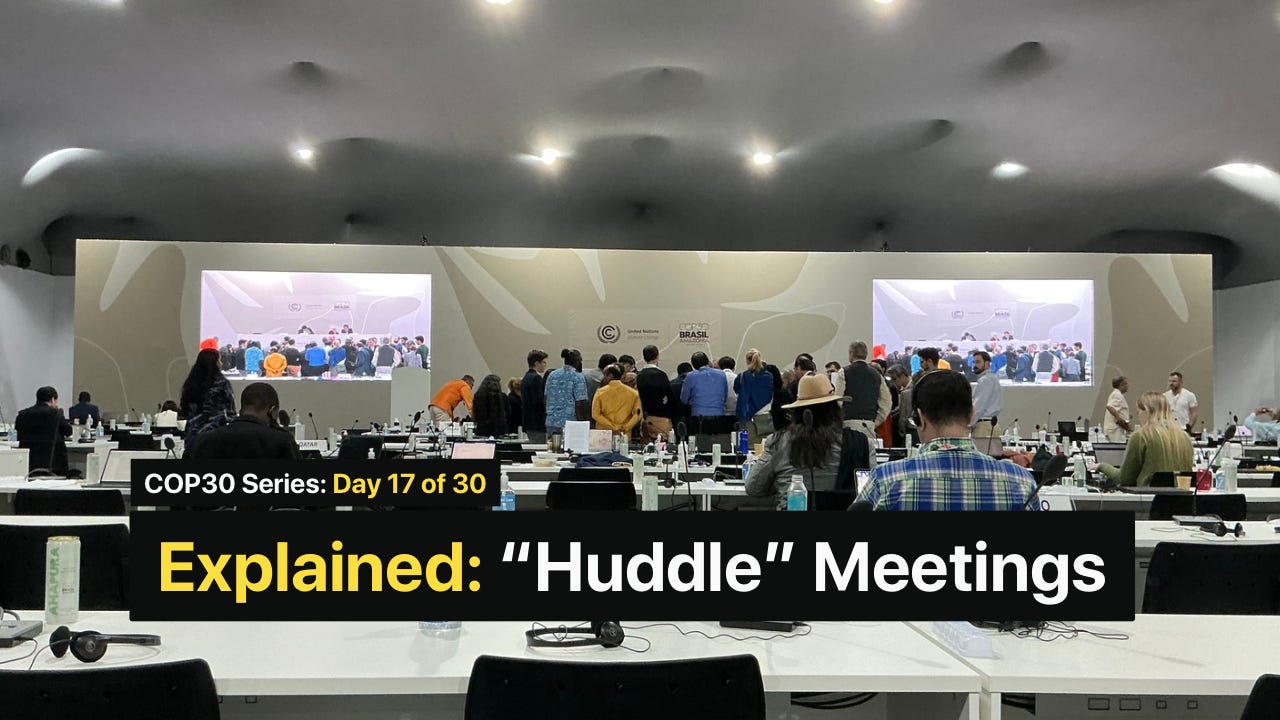
Suddenly, the facilitators ask the negotiators to “huddle”, they leave their seats. But, they do not leave the room.
They “spontaneously” form a tight, “chaotic” circle in a corner. They are leaning in, speaking in low voices, and one person is typing furiously on a laptop.
This is the “huddle.” It is where the real deal is being cut.
If you do not know what it is, you will be left sitting at your desk while the decision is made without you. This is your guide to the most important meeting that is not a meeting.
How a Huddle Unlocks a Deal
When the formal meeting doesn’t move fast enough or breaks down, Parties need a different, “unstructured” way to talk. The huddle is one of the most common tools.
It Forms Spontaneously: A huddle is a very direct exchange. It is not run by the official facilitators, who choose to stay out of this gam to give Parties space. It is started by the “most actively engaged groups” who want to “bash out a way forward.”
Coordination First, Negotiation Second: This is a key two-step process.
Step 1: Your allied negotiating group “may begin by forming their own huddle” in one corner to “coordinate and confirm their room for manoeuvre.”
Step 2: Then, they will move “within the room to engage with other groups in a larger huddle.”
Live Drafting: This is not just talk. This is where the text is rewritten on the spot. One negotiator usually stands up as a facilitator working on one or multiple laptops.
It Must Be “Reported Back.” A huddle cannot actually be a result. Whatever compromise is found must be brought back to the full meeting presented by one of the participants. as a “report back”.
You Must Be in the Huddle
The lesson is simple: Your strongest ally must be in that huddle.
This is not a formal, transparent space where everyone gets a turn to speak. It is raw, fast-paced, and exclusive. If your ally isn’t well-informed by you and not in that tight circle, your position will be missing from the “preliminary solution” that is presented back to the room.
Why Huddles are Deeply Unfair
Huddles are effective, but:
Not everyone can participate. By nature, only a few people can fit.
It can be hard to hear and to be heard.
Parties often complain, when work is reported back, that they had faced problems in taking part. So usually there are “pre-huddles” or “side-huddles.”
Before You Go
In a huddle is where your alliance pays off. Your job is to follow your allied negotiator, and feed him/her.
The goal of this chaotic huddle is to find a compromise that everyone can live with. This brings us to the core concept of the entire conference.
Tomorrow I we will explain “Consensus” and why “winning” at COP means everyone goes home a little unhappy.
See you then!