
I shaped WHO treaty language from across town. Here's how.
On the Pandemic Agreement's PABS Annex.
Good morning team,
Let me walk you through something most people have never heard of.
This week governments from around the world were sitting in Geneva negotiating something called the “PABS Annex.”
Sounds boring. It’s not.
PABS stands for Pathogen Access and Benefit-Sharing. In plain language: When a dangerous virus is discovered somewhere in the world, who gets access to it, who gets to turn it into a vaccine, and who gets paid?
That question is being answered right now. Behind closed doors.
Here’s some quick context so this makes sense.
Last May, the World Health Organization adopted something called the Pandemic Agreement, it’s basically a global rulebook for how countries should work together during the next pandemic.
But that rulebook has a missing chapter. The PABS Annex is that chapter. And without it, the entire agreement is frozen. Countries can’t even sign the treaty until this part is finished.
They have 12 negotiating days left before the May deadline.
I’d love to be in that room negotiating this.
I can’t.
The International Indian Treaty Council ( the organization I work through) isn’t accredited to the WHO. So I can’t sit in on these talks. I can’t speak. I can’t raise my hand.
What I can do is work through friendly State delegations that have their own negotiators inside. We chat, I feed them text, analysis. I send messages. I coordinate.
On Monday, the very first day of this week’s talks, I was across town at the Palais des Nations for the Human Rights Council organizational meeting, preparing for 5 weeks of absolute chaos. Two rooms in Geneva. Same day. Different UN buildings. Both making decisions that affect Indigenous Peoples.
Then my phone started buzzing.
Text messages from States inside the WHO room.
The first fire of the week had already started.
The Monday Fire
Here’s what happened, and why it matters even if you’ve never followed a UN negotiation in your life.
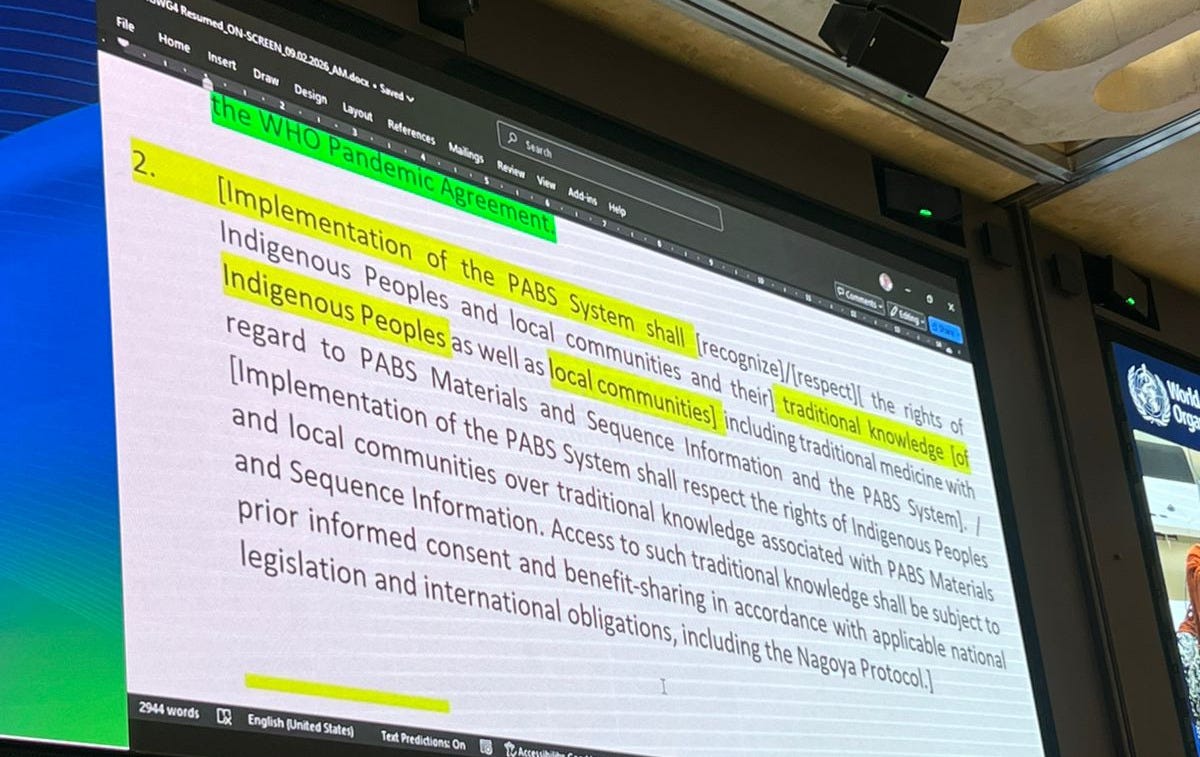
In the negotiating text, language appeared that lumped “Indigenous Peoples” together with “local communities”, and it would effectively give rights to “local communities” as a legal category.
If you’re new to this, let me explain why that’s a problem.
Under international law, Indigenous Peoples have specific, recognized rights. There’s a UN Declaration that says Indigenous Peoples have rights to their lands, territories, resources, self-determination, and something called “free, prior and informed consent.” That last one means you can’t take things from Indigenous territories without asking first and getting a real “yes.”
“Local communities” don’t have any of that. They’re not a recognized legal category. There is no UN declaration for local communities. No convention. No specific rights.
So when you mash the two together “Indigenous Peoples and local communities”, you’re not lifting local communities up. You’re dragging Indigenous rights down. You’re giving equal say to groups who might have completely different interests, while undercutting a legal framework that took over three decades to build.
The UN’s own experts have opposed this conflation. Indigenous Peoples worldwide have called for it to stop.
And yet, on Monday, that exact language showed up in the PABS text.
So here’s what I did. I immediately started coordinating with the State delegations that had flagged it. I sent a Whatsapp analysis on why the conflation is legally dangerous and gave alternative language.
That’s the infrastructure we’re working with. Text messages between buildings. It’s not ideal. But it works IF you have the relationships and the knowledge to move fast.
No jokes. Sometimes I’m referred to as an UNDRIP ChatGPT for negotiators lol.
Why You Should Give A Sh*t
Let me back up and explain why this affects more people than you think.
When scientists discover a dangerous virus, they sequence it, meaning they read its genetic code and turn it into data.
That data is incredibly valuable. Companies use it to develop vaccines, tests, and treatments. A single genetic sequence can be downloaded, patented, turned into products, and sold around the world.
Where do most of these viruses come from?
They come from the most biodiverse places on earth. Forests. Mountains. Wetlands. Places where animals and humans live in close contact.
And who lives on those lands? You guessed it.
We. Indigenous Peoples. Often for thousands of years.
These ecosystems don’t just contain dangerous viruses. They also hold medicinal plants and traditional knowledge about how to fight disease, knowledge built and passed down across generations.
PABS is supposed to make sure that when a virus is shared globally, the benefits (vaccines, funding, technology) get shared fairly too.
That’s the claim.
Here’s the problem.
What’s Actually Being Built
The current PABS design has two main players: Governments and pharmaceutical companies.
Governments control who gets access to virus samples. Companies turn that data into products. A global fund distributes some benefits.
Indigenous Peoples are not part of the equation.
No requirement to ask for their FPIC before collecting samples from their territories.
No recognition of their traditional knowledge about diseases and medicine.
No seat at the decision-making table.
Through delegations, I have flagged this directly: The PABS system doesn’t even consider the possibility that Indigenous Peoples hold knowledge related to the pathogens being collected from their lands.
There are also specific legal dangers that anyone following this should understand:
Samples without FPIC: Viruses and genetic data can be collected from Indigenous territories and moved into a global system where Indigenous Peoples have no voice.
A legal loophole: Existing international law already says you need to share benefits when you use genetic resources from Indigenous lands. But if PABS becomes the official system, governments and companies could argue that using PABS alone is enough, even if Indigenous Peoples were never consulted.
Secret contracts: Previous WHO agreements used confidential terms with weak accountability. If you can’t see the deal, you can’t challenge it.
Knowledge made invisible: Indigenous Peoples contribute crucial knowledge about ecosystems, disease patterns, and medicinal plants. PABS treats virus samples as neutral raw material. That knowledge gets used. It never gets credited.
The Two-Room Trap
Here’s the strategic layer.
At the same time PABS was adopted last May, the WHO also adopted a separate 10-year strategy on Traditional Medicine.
One negotiation governs the viruses. The other governs the traditional knowledge and the plants.
Same resource. Split across two rooms.
This pattern shows up everywhere in the UN system. One body handles genetic data from nature. Another handles carbon from forests. Another handles patents. Another handles ocean resources. Every single one follows the same design:
Take the resource, move the value into a global system, and treat Indigenous Peoples as “stakeholders”, a polite word that means you get to watch, but you don’t get to decide.
What I’m focused on is making sure we don’t get blindsided by money and share this with you so that we don’t fight these rooms one at a time. The strategy has to connect them. When we talk about what’s happening in the WHO room, you should see the the link to what’s happening in the climate carbon market talks under Article 6, and the patent discussions at WIPO. Because it’s the same architecture repeating itself.
The Bigger Picture
Here’s the part I need you to understand.
The wealth of the last century was oil, gold, and minerals. You dig it up, sell it, it runs out.
The wealth of this century is genetic information. A virus code. A plant gene. Traditional knowledge about how to use it.
You can copy genetic data. Sequence it. License it. Sell it. Forever. A mine runs out. A genetic library never does.
The richest genetic libraries on earth aren’t in labs. They’re in biodiverse ecosystems. On Indigenous lands.
The countries and companies that control this information will shape the future economy. This isn’t just a health negotiation. It’s a land deal. A knowledge deal. A power deal.
Before You Go
On Monday, I was sitting in one UN building while getting text messages about what was happening in another.
That’s the reality of how this work gets done. It’s not glamorous. But every text message, every piece of analysis, every relationship with a delegation? That’s how you influence a room you can’t enter.
Here’s what I’d ask you to do.
If you work in Indigenous rights, health policy, or international law, learn the PABS architecture. Understand how it has a similar template as in the biodiversity and climate negotiations. The same design is being copy-pasted across every treaty.
The PABS Annex must be finalized by May. It appears that the WHO has 12 days of talks left. And I’ll be here, doing what I do, feeding analysis, building relationships, suggesting text, connecting the dots across rooms.
Because the rules for who owns the biology of the future are being written right now.
That’s it for this week.
See you next Saturday!
P.S.: I wrote a deep dive on this
