
I asked 3 questions in the room and IPLC disappeared from the draft.
Another tool for your deconflation toolbelt.
Happy Saturday,
This message below was shared 25 times after I posted it on Threads.
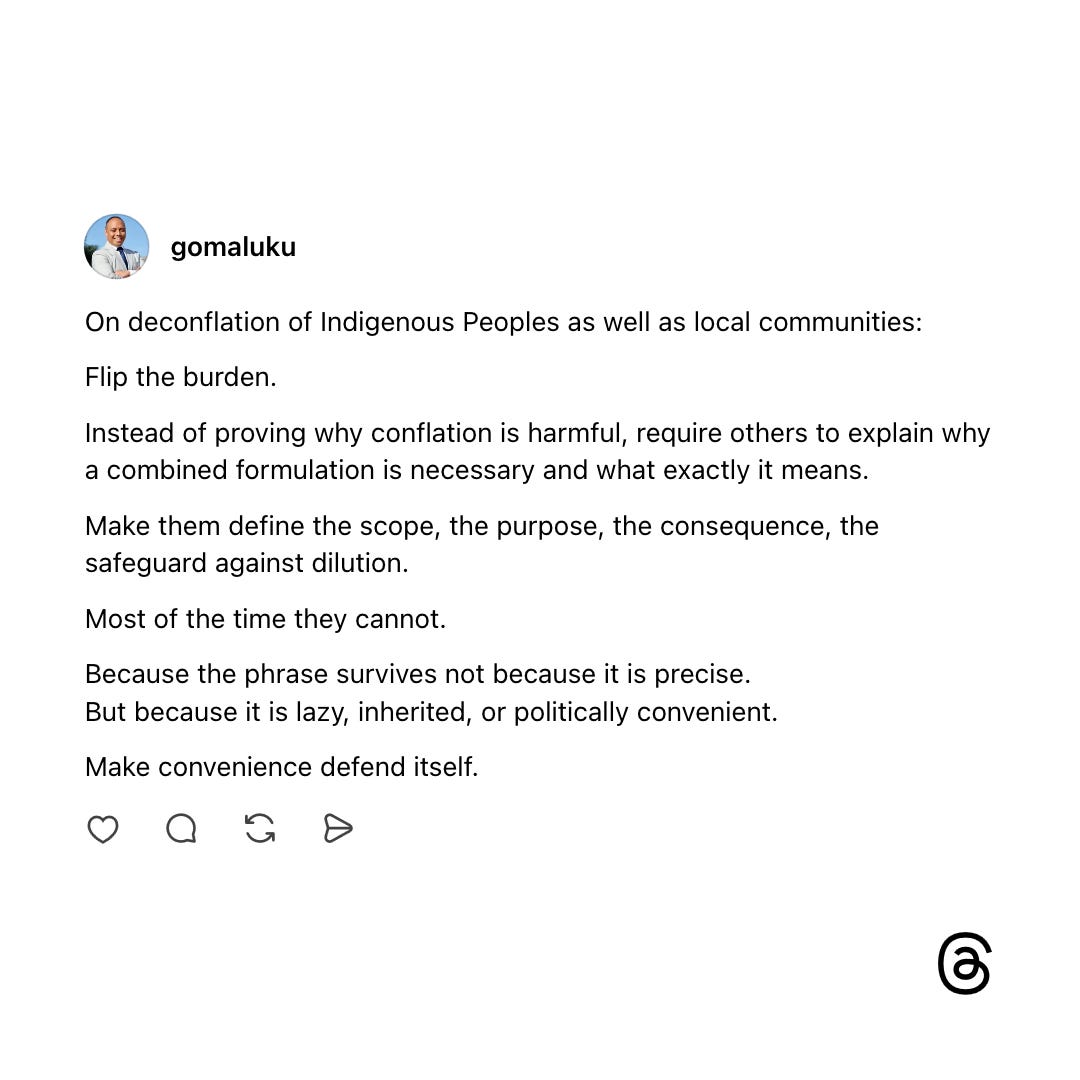
Let me expand on it.
In human rights spaces, the distinction between Indigenous Peoples and local communities is usually clear. Local communities aren’t a subject under international human rights law. So the phrase doesn’t stick the same way there.
The problem is international environmental law.
The CBD keeps putting “Indigenous Peoples and local communities” into texts. And the Indigenous caucus there isn’t actively trying to fix it. I’d even argue some benefit from the conflation.
That language doesn’t stay at the CBD. It spreads.
Look at paragraph 135 of the Paris Agreement. It talks about the traditional knowledge of Indigenous Peoples and local communities. The text doesn’t actually treat us as one group. But people interpret it that way because they bring the CBD mindset with them.
Same thing at the Food and Agriculture Organization. At UNEA. And now we might have this problem at the UNCCD.
The CBD is the source. And because nobody there is cleaning it up, the rest of the environmental ecosystem keeps copying the same pattern.
Why your reasons don’t work.
You can explain why Indigenous Peoples are different from local communities. You can point to UNDRIP. You can say that local communities aren’t a subject of international human rights law. You can make the moral case. And it works….in Geneva.
But here’s the thing. Many states are allergic to bringing international human rights law into international environmental law. They don’t want those frameworks mixing. So when you show up with a human rights rationale in an environmental room, it often doesn’t move anyone.
The moral argument is correct. It’s just not enough by itself in these spaces.
So I needed something else. I’ve been test-driving a different approach. It’s working. And it’s another tool in your Batman belt. You decide when to use it.
How I use it in different settings.
In general statements, I still make the legal distinction clear. At BBNJ, I said it plainly: As a matter of principle, we oppose the conflation of Indigenous Peoples as well as local communities. Local communities are not a subject under international law. Indigenous Peoples are. The two are not the same.
That’s the formal marker. It goes on record in the plenary.
But in bilaterals and informals, when someone is really pushing for the conflated phrase, I do something different. I don’t keep explaining. I start asking questions.
Flip the burden.
Here’s what I’ve noticed about the old approach.
When we explain why Indigenous Peoples are different from local communities, we put ourselves in the hot seat. We’re providing evidence. We’re making the case. We’re doing all the work while the other side just shrugs and keeps the language they wanted.
They don’t have to defend anything. They just wait for us to finish talking, then move on.
That’s the trap. So I flipped it.
I stated the principle first: As a matter of principle, we oppose conflation of Indigenous Peoples and local communities.
Then I bilaterally asked proponents who treat the two as one group to answer some questions.
Not fancy questions. Simple ones. Questions so clear that a child could understand them. Questions that force them to explain what their own language actually means.
The questions I used.
“I want to make sure I understand this. When you use this phrase, are you talking about one group or two groups?”
Then I waited.
If they say one group, I ask: “Then why are there two names?”
If they say two groups, I ask: “Then why does this text treat them as one thing?”
Then I keep going:
“When we set up the participation process, will there be one seat or two?”
“When someone needs to be consulted, who exactly gets consulted?”
“If you consult local communities, does that count as consulting Indigenous Peoples?”
“If there’s funding, does it go to one pot or two?”
“Who decides who represents whom?”
These questions are simple on purpose.
If someone has to think about what my question means, they’ll answer their own interpretation of it. And then we’re back to arguing about interpretations instead of pinning them down.
Clarity is the whole game here.
Why this works.
The phrase “Indigenous Peoples and local communities” survives because it’s vague. That vagueness is useful. It lets institutions claim they included Indigenous Peoples without actually setting up distinct processes, distinct seats, distinct funding, distinct anything.
When you ask simple operational questions, you take away the vagueness.
Now they have to say out loud what their language actually means. And most of the time, they don’t want to. Because whatever answer they give creates problems for them.
If they say it’s one merged group, that contradicts international law.
If they say it’s two separate groups, then why not just write it that way?
The phrase works precisely because nobody has to answer these questions. Making them answer is the move.
One thing I always do.
When I talk about this issue, I never say “Indigenous Peoples and local communities” unless I’m quoting the text directly.
At the BBNJ we’re discussing a proposed IPLC advisory body and that’s what the document calls it, I’ll use that name so people know what I’m talking about. But in everything else I say, I refer to the Indigenous Advisory Mechanism by name. I make the distinction in my own speech, every time.
This matters because language shapes how people think. If I blur the line in my own words, I’m doing their work for them.
What this gives you.
This isn’t a replacement for the moral argument. It’s another tool in your Batman belt.
The moral argument says: Indigenous Peoples are not the same as local communities. Our rights are distinct. Our histories are distinct. Conflating us erases that.
That argument is true. Keep making it.
But when that argument isn’t moving the room, you now have another move. You state your principle. Then you put the burden on them to explain what their language actually means.
It’s up to you when to use which. Sometimes the moral argument lands and that’s enough. Sometimes you need to pin them down with operational questions. Sometimes you use both.
The point is you have options now.
Before you go (yes, it’s back).
The trap is thinking you need a perfect argument.
You don’t. You need a good question.
A question they can’t answer is worth more than an explanation they can ignore.
Next time someone puts Indigenous Peoples in the same phrase with local communities, don’t just give a speech. State your principle. Then ask: “So when this gets implemented, how exactly does that work? One group or two?”
Then wait.
See you next week!
P.S.: I upload daily briefs on my Substack. Here is what twelve days of negotiations across two processes covered:
I showed three rules for tweaking negotiating text. If your edit fails any of them, do not propose it.
I used a power adapter to explain how you keep connection points open inside treaty architecture. Sixty seconds. Worth more than a strategy document.
A co-chair gave me two minutes. I took one. I showed how listening to the room cuts your time in half and doubles your credibility.
The ambassador of Vanuatu said something over kava that made three of us stop talking. I unpacked why tactics expire but principles do not.
I laid out the one red line I refuse to cross on Indigenous representation. And I showed why I pick a worse seat every time if it means we choose who sits in it.
I explained why FPIC breaks at version six. If you work on data, genetic resources, or traditional knowledge, this changes how you think about consent.
The BBNJ closing plenary went sideways. I shared the two texts I sent the IITC group chat in real time and then did the full post-mortem.
I showed how I calculate mid-week whether a proposal will survive the next text. I did the math on Friday. By Sunday I was right.
I walked into a new treaty negotiation seventy-two hours after landing. I shared the sawdust technique: when the room will not let your language survive whole, you break it into dust and sprinkle it through the text.
I mapped six months of overlapping processes from one chair and showed how I decide which one gets my full attention and which ones I let breathe.
I revealed a project I have been building for two years: An ICJ advisory opinion on state obligations and Indigenous rights. That is the real reason I am going to the permanent forum.
I found out about a special procedures meeting with civil society that is not on any public calendar. Now I track it.
The full daily briefs go deeper. Become a team member.