
If I had 1 shot at this? I'd prepare a shadow paragraph, not a speech.
On why prepared statements lose to a page full of brackets, and the tool that doesn't.
Tabea, happy Saturday.
The Committee on World Food Security session had just wrapped in Rome, and it was a long one. By evening it was still stupid hot outside FAO headquarters.
But, there’s a street right outside with a row of cafes, so a few of us walked out and sat down to unwind. Conversation drifted between English and French, nothing serious, just people decompressing after a hard week.
Then one of the farmer representatives at the table said, almost as an afterthought, “Yeah, by the way, those negotiating texts on the screen. I still have a hard time with them.”
I told them that’s completely normal. If you’re a farmer, you didn’t go to diplomacy school, and nobody should expect you to read a wall of brackets like it’s second nature.
They seemed relieved that I’d been there earlier in the week to help untangle some of that language. Then they asked me straight up, which negotiation course or training should they take?
That question is where this whole answer started.
Why negotiation training doesn’t help
My answer surprised them. Most negotiation training won’t prepare you for a textual negotiation. It’ll teach you how to prepare: Interests, positions, leverage, trust, maybe body language, your best alternative to a deal. All of that has real value. I’m not going to sit here and tell you it’s worthless.
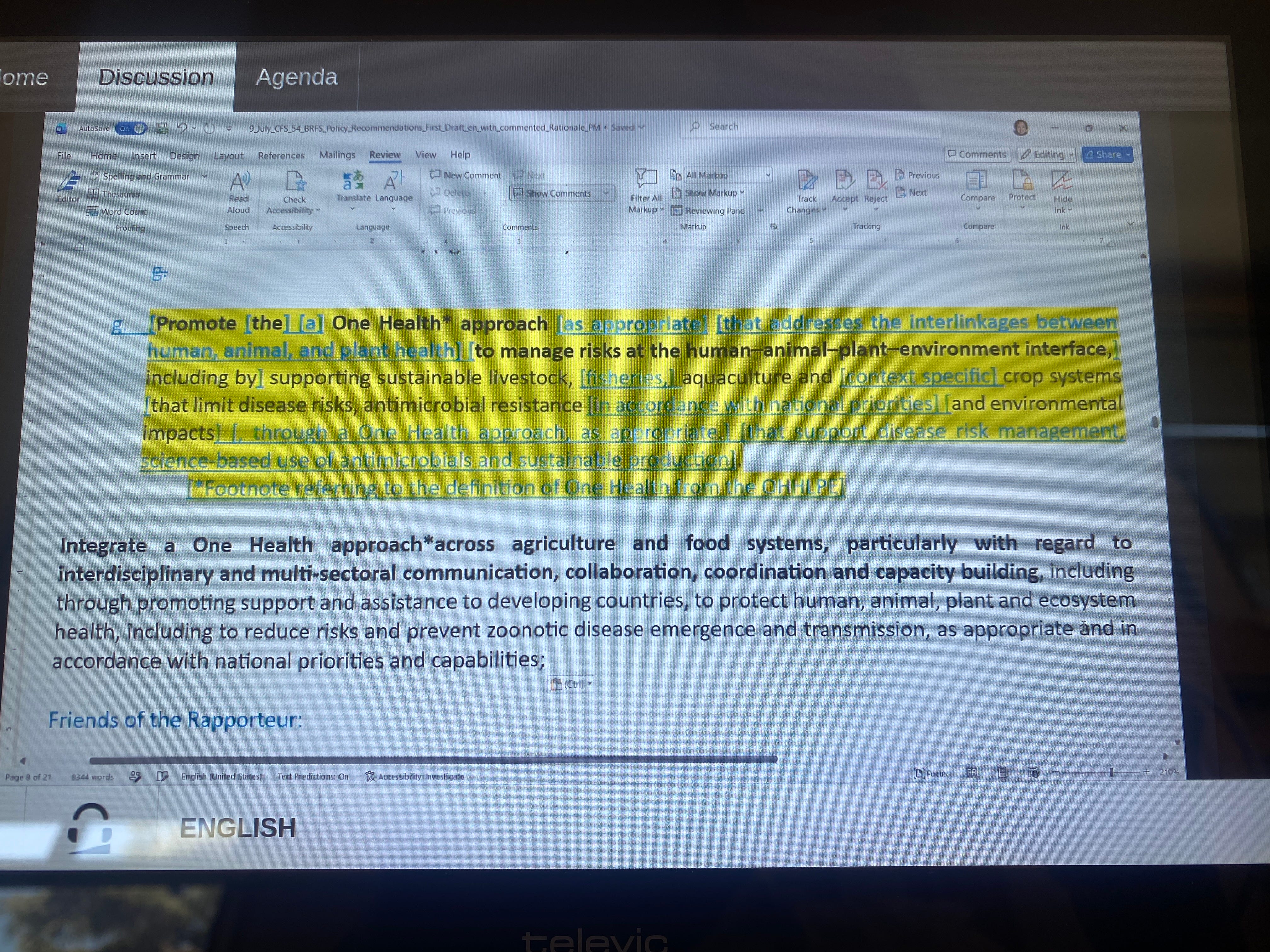
But then you walk into a United Nations negotiation. A paragraph goes up on a big screen. It’s full of brackets.
Imagine this. Five States want five different versions of the same sentence. One wants to delete half of it. Another adds “as appropriate.” A third adds “in accordance with national circumstances.” A fourth wants to swap “shall” for “should.” The secretariat is typing changes faster than the chair can explain what just happened.
Then the chair looks at you and gives you the floor. You’ve got seconds. That’s the exact moment your training stops helping.
I still remember the first time this happened to me. Paris, then Bonn, then Poland not long after. I walked in with our statement printed, folder tucked under my arm, feeling ready. Then the paragraph went up on the screen and it looked nothing like the version I had prepared for. Half of it was struck through. New phrases were stacked on top of each other in brackets, three or four options fighting for the same spot in the sentence.
I sat there trying to work out what each new word was actually doing. Trying to remember which State had proposed which change, because that tells you who to talk to later. Trying to hold on to our position while also deciding whether to raise my hand. My statement was ready. But, it felt useless already.
I had a statement. A good one. We’d sat with our caucus before the session, talked through what mattered, agreed on the values we were defending. It said Indigenous Peoples must be included. It said our rights must be respected. It laid out what our people were actually facing on the ground. Every word of it was true.
Then the co-facilitator turned to me and asked a simple question. “What exact text are you proposing?”
I didn’t have an answer. Not a real one. I could tell you the principle. I could tell you exactly what our people were facing. But point to the paragraph and say which words come out, which words go in, and what the new sentence should actually read? I couldn’t do it on the spot. Nobody warns you about that gap. You just find it, standing there with a statement in your hand and nothing useful left to say.
That’s the part that still gets me, to be honest. The statement itself wasn’t wrong. It answered a version of the paragraph that no longer existed by the time I got the floor.
Your brain when the screen fills with brackets
Here’s what’s happening in the room while all this is going on.
You’re reading the paragraph. You’re listening to whoever’s speaking. You’re watching the secretariat delete a word and add three more in real time. You’re trying to remember your own instructions from your traditional council back home. You’re guessing whether the new change helps you or hurts you.
And somewhere in the middle of all that, the person next to you leans over and whispers, “What do you think?” Your WhatsApp chat blows up.
Your brain can’t hold all of that at once. Nobody’s can. Working memory has limits, and this format hits every single one of them at the same time. You reread the same line three times. You catch one change and miss the next. You look around for someone, anyone, to tell you what to do. And because your prepared statement is the one thing in your hands that still feels solid, you read it anyway.
Meanwhile the room has already moved on.
A State may have already added the exact idea you wanted, or another one may have quietly gutted it while you were still catching up. The whole room might now be fighting over one phrase, or one comma. Your statement can be completely true and still be useless, because you’re answering last week’s text while the room is writing this week’s.
What is a shadow paragraph?
Here’s the shift that actually fixed this for me.
Most people prepare by asking what they want to say. An Indigenous diplomat asks a different question. What do we want this paragraph to become? That second question is the one that changes outcomes.
I call the tool a shadow paragraph.
Take the paragraph in front of you and write the version you’d want if your people held the pen. The actual sentence, not just the principle behind it.
Where should “Indigenous Peoples” show up in the text?
Does it name UNDRIP, or human rights, or international standards?
Does it protect a right, or does it quietly hand that right over to national law?
What happens to the sentence if someone slips in “as appropriate”?
Does it still do its job?
How to triage a negotiating text
You can’t write a shadow paragraph for every line in a long negotiating text, and honestly, you shouldn’t try.
I’m guessing you have a small delegation, and a small one doesn’t have the people or the hours for that. So I suggest you triage. Like in a hospital.
Some paragraphs touch your rights, your lands, your knowledge, your safety directly, and those you defend with everything you have.
Some would be nice to improve but aren’t the real fight.
And some you can live with in almost any form.
It’s just math when you only get one or two shots at the floor. In most rooms you get called on once, maybe twice, so you spend that floor time where it actually counts.
FAO’s Committee on World Food Security gives Indigenous Peoples more room to speak than most spaces do, but even there you still have to watch the wording closely. You can’t fight every bracket. You have to know which ones are worth the fight.
For the paragraphs that matter most, I write three versions.
The ideal text, the one that says exactly what I need.
The fallback, weaker but still doing the job.
And the red line, the lowest point I’ll accept.
For Indigenous Peoples, that red line should never sit below UNDRIP. Not negotiable.
Why “as appropriate” can quietly gut a right
This is also why little words like “as appropriate” or “where applicable” matter way more than they sound like they should. The first time you see one, it reads as harmless filler.
Once you’ve watched a State add one on purpose, you start asking real questions.
Who decides what counts as appropriate?
Who decides when the right applies?
What happens when national law is weaker than the standard everyone already agreed to?
Once you know exactly what your paragraph needs to do, and what it must never do, those questions get a lot easier to answer fast.
Why your comparison text should be gospel
The last piece is your comparison text. A past resolution, an agreed decision, a treaty article, language straight from UNDRIP. Know it like gospel. The old text wasn’t perfect. But you need that baseline to tell whether a new proposal is a real compromise or a quiet step backward dressed up as one.
I still feel the overload, by the way.
I felt it again recently reading the draft legally binding instrument on business and human rights, which is its own soup of brackets and competing language.
Experience doesn’t make that feeling go away. It just gives you a method for it. I walk in already knowing the job of the paragraph, carrying the baseline, holding my ideal version, my fallback, and my red line.
Don’t get me wrong. Prepared statements still matter.
They frame the issue, remind the room what’s at stake, and carry the voices from the ground into a cold meeting room. But a statement tells the room what you believe. A shadow paragraph tells the room what you want it to adopt. Sometimes the whole fight comes down to one word, or one comma, and a good statement isn’t going to save you there.
Prepare your statement. Then go further and prepare the paragraph. Prepare the fallback. Prepare the red line. Know what the text must do and what it must never do.
Carry your comparison text like gospel.
Before you go
The mistake I see most often happens the weekend before.
A team sits down, goes through the whole text together, writes down the version they want, and treats it as gospel. I have done this myself. It feels like preparation. It actually makes you rigid.
The room moves, a co-chair floats a landing zone, another delegation swaps one word, and now your fixed text does not fit anymore. Have the shadow paragraph, yes. But have the bandwidth around it too, the ideal, the fallback, the red line, so you can move inside that range instead of freezing the moment the target shifts.
The other thing people forget is that a paragraph never sits alone.
We stare at what is on the screen and read it in isolation, when the real skill is holding the whole document in your head at once.
If section 1, paragraph 1D changes, does that touch section 3, paragraph 2C?
A pro move is putting a note in the margin of your own document: If this changes to that, here is what it does over there. Keep an eye on the big picture, not just the bracket in front of you.
That’s it for today.
See you next week.