
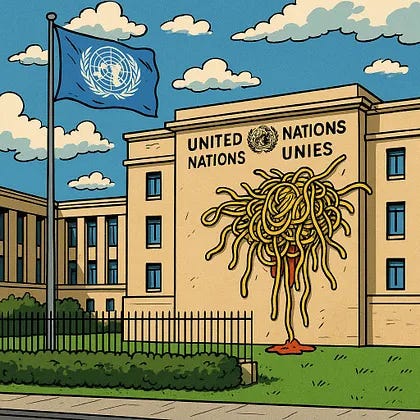
I Stopped Throwing Spaghetti at the Wall
How my initial Indigenous advocacy work failed before I even started
Writing this I recall the note I scribbled at the climate summit in Madrid, we’ve been working on Article 6. Had our language ready. Built relationships with supportive States. Did all the prep work you're supposed to do.
First week of COP25, we're pushing hard to get human rights and Indigenous Peoples' rights directly referenced in the Article 6 text. Making our rounds. Having bilateral meetings. Building momentum.
Then we started seeing the contact groups, and iterations.
Nothing. Zero direct references to human rights or Indigenous Peoples' rights in any of them: 6.2, 6.4, 6.8.
Here's What Actually Happened
We had champions. States that said they supported us. We had solid technical arguments. We had moral authority on our side.
But when push came to shove, when text actually got written, nothing. We got text messages from delegations that basically meant nothing. Mainly because we were going at it all wrong (but that’s for another time).
Meanwhile, I watched other issues get locked into the operative text with specific implementation mechanisms and clear mandates.
Same negotiation. Same timeframe. Completely different outcomes. Luckily, Article 6 tanked in Madrid and we had another shot at it in Glasgow the next year. Which gave us the opportunity to regroup and approach it differently.
That's when it hit me. I've been watching this pattern for years without really seeing it.
The Three Variables Nobody Talks About
After bombing in Madrid, my notes before that COP and other processes actually outlined variables that separated success from failure. Turns out there are three things happening simultaneously that nobody ever explains. Until now.
Variable One: The Platform
Every platform has written rules. But the written rules are just the tip of the iceberg.
At climate negotiations, everything's supposedly done by consensus. But real power lies with those that know how to incrementally do stuff, know the art of agenda-setting and bracketing text, and whoever leads the “huddle”, these are rules that aren't mentioned anywhere in official procedures.
If bracketing texts is common in Bonn, don’t even try to bring up brackets in Human Rights Council thematic resolution negotiations. That platform relies on the informal consultations. That’s exchanging views on texts for 1,5 hours on Monday morning, again in the afternoon, and on Wednesday for 3 hours before the scond iteration comes out, or calculating probability of success based on who’s in the core group, or using the ability to co-sponsor (or not co-sponsor) resolutions as a weapon.
At the General Assembly? Entirely different from HRC, and voting is their default way for decision-making.
Variable Two: The Culture
Each platform has its own DNA. Miss this, and you're speaking the wrong language entirely.
Geneva values legal precision, understatement, procedural correctness. Emotional appeals seem unprofessional. Personal stories feel like manipulation.
New York is more political, voting-oriented. Emotional appeals work if tied to current events. Strategic and/or constructive ambiguity is expected - as well as delays. Lengthy negotiations to arrive at the same point where you started.
I learned this the hard way. Early years in Geneva, I didn’t know what I was doing, I was passionate and direct. Fiery speeches in room XX about injustice and decolonization.
Content was accurate. Passion was genuine. Delivery was completely wrong for that space to actually get something done.
So I adapted. Went to the basement (literally). Learned to lean into the informal negotiations. Made progress through planting seeds in various resolutions. Built relationships through quiet conversations.
Suddenly people started listening. Same person, same expertise. Different approach to Geneva’s invisible operating system.
Variable Three: The Protocol
Even within the same room, different delegations require completely different approaches.
During the BBNJ marine biodiversity negotiations, I pitched Indigenous representation on all subsidiary and scientific bodies to five different delegations and groups. For example, my approach to Thailand was very different than my approach to the Canadian or Brazilian delegation. Same proposal, but tailored to each delegation.
All five supported it for completely different reasons.
The Pattern That Changes Everything
Once I saw these three variables, everything clicked. In Madrid, we had great content but missed key variables about how that specific negotiation actually worked.
Why Glasgow succeeded? We understood what game we were actually playing.
Most people focus on being right. The smart ones focus on being effective within the specific variables they're working with. So, when I/we went into bilaterals my talking points went through this:
Platform: Where am I and what rules apply?
Culture: What language or behavior gets listened to, and what gets ignored?
Protocol: What behaviors (written or unwritten) make my message stick?
Before You Go
I spent years thinking these rooms were broken because they didn't reward moral clarity. Turns out they're not broken, they're just operating by rules nobody ever explains.
Once you see the variables, you can start working with them instead of against them.
See you next week!