
20 years in. Losing still stings. Here is how I move.
On how I I lost a UN recommendation, and moved in 45 minutes.
Tabea, happy Saturday,
Yesterday, I was standing in my kitchen doing a full Super Bowl breakdown in my head.
Not plays from a game. Words from conversations, meetings. The exact sentence the person used when they told me the recommendation wasn’t going to make it into the PFII25 final report. I was running it back, frame by frame. Slowing down at the moments I could’ve accelerated, be more or less aggressive. Looking for the version where I said something different and the whole thing changed.
That is what anger looks like when it sneaks in wearing the clothes of analysis.
Here is what made it worse. We had done everything right.
We had done everything right
Three versions of the language. A directive version naming the ICJ directly. A middle-ground version. An ambiguous version so softened it was basically a whisper.
Directive: “The Permanent Forum recommends that States, in consultation and cooperation with Indigenous Peoples, explore the possibility of requesting an advisory opinion from the International Court of Justice, on the obligations of States to implement the rights recognized in the United Nations Declaration on the Rights of Indigenous Peoples.”
Middle ground: “The Permanent Forum recommends that States, in consultation and cooperation with Indigenous Peoples, explore available judicial and advisory avenues within the United Nations system, including through the principal judicial organ of the United Nations, to clarify the obligations of States to implement the rights recognized in the United Nations Declaration on the Rights of Indigenous Peoples.”
Ambiguous: “The Permanent Forum recommends that States, in consultation and cooperation with Indigenous Peoples, explore appropriate legal, judicial, and advisory avenues available within the United Nations system to clarify the obligations of States to implement the rights recognized in the United Nations Declaration on the Rights of Indigenous Peoples.”
We did our due dilligence, every delegation from Indigenous south had something they could live with. The logic was airtight. The political opening was real.
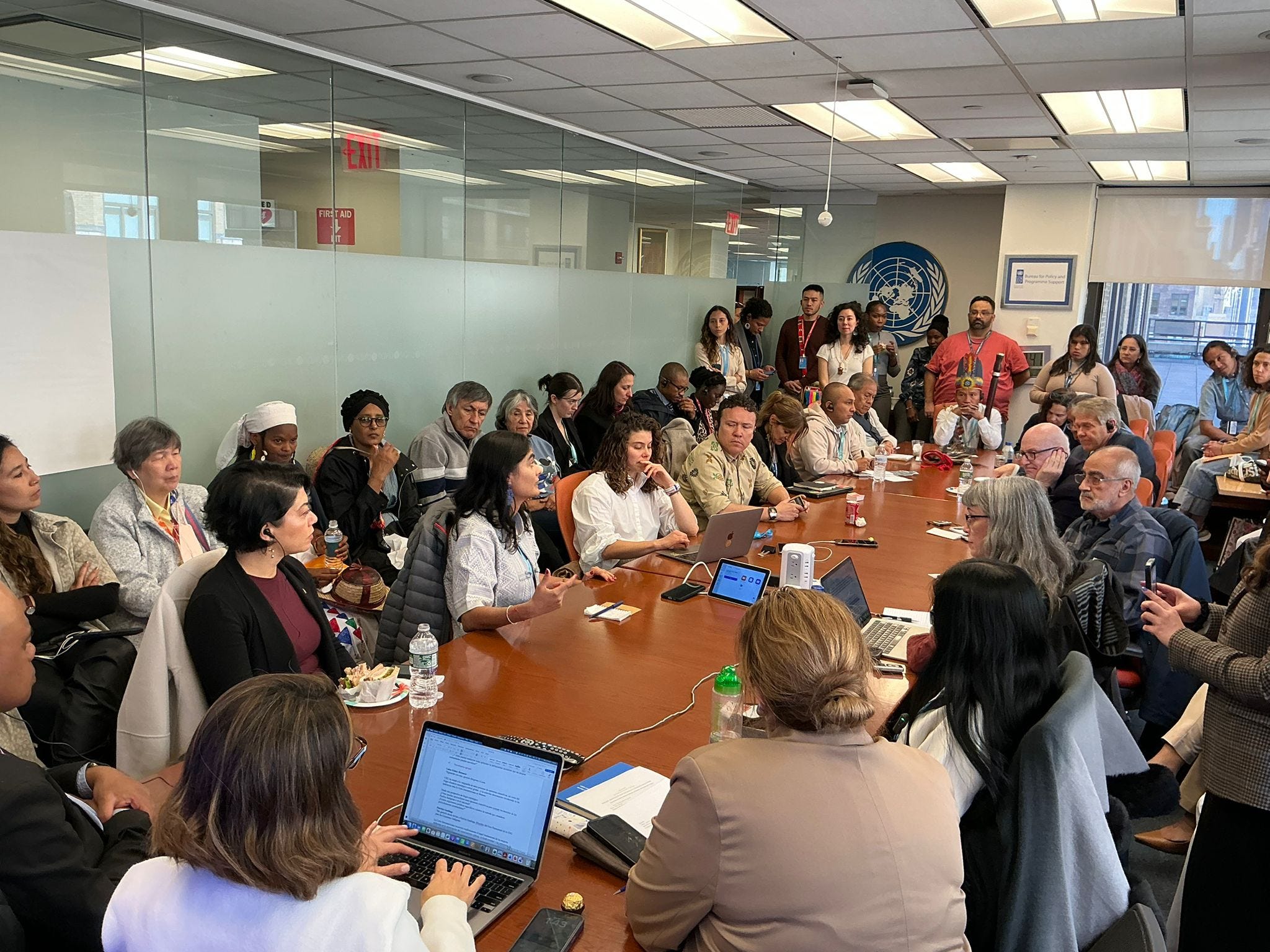
We had side events so oversubscribed people were standing outside catching the conversations through interpretation devices. A Thursday workshop on the 22th floor that ran three hours with high engagement and still people wanted more. A dinner with experts, leaders, UN staff, and negotiators where the conversation was, in two words, chef’s kiss. A brief, an FAQ tab, a roadmap tab, a safeguards tab.
We walked through session as prepared as we have ever been for anything.
It still didn’t land.
The part nobody says out loud
Here is something most people outside these rooms do not know. The final report of the Permanent Forum is not a summary of what was discussed. It is a negotiated document. Every recommendation in it has to survive a drafting process where members decide what goes in and what stays out.
You can make the case on the floor. You can socialize it in side events, workshops, bilateral conversations. You can have ambassadors ready to take it to capital. And at the end of it all, a small group of people sits down to write the report, and if the language doesn’t have enough support in that room, it doesn’t make it in. No vote. No formal objection. It just disappears between drafts.
That is not a flaw in the system. That is the system.
I know exactly why the ICJ AO recommendation didn’t land. In the case of your recommendation(s), maybe it was one person with a feeling. Maybe it was the political climate, the budget pressure, the noise from the UN80 process running parallel in a different room. Maybe it was all of it. In multilateral negotiations (including amongst members of PFII), you rarely get a clean answer.
What you need to know is this. You can build the most careful, layered, well-reasoned case in the world. You can give everyone in the room something they can live with. And still walk away with nothing. No argument. No counter-proposal. Just nothing.
You do not need to know what an ICJ Advisory Opinion is to recognize that moment. The pitch that was going perfectly until the final meeting. The proposal that was almost there until it wasn’t. The project that died not from logic but from something you will never fully be able to name.
Anyone who has ever built something carefully and watched it disappear at the last second knows exactly how that sits in the body. The frustration. The low-level hum behind everything else you are trying to think about. The thing you swallowed that won’t go down.
You are supposed to feel that.
And anyone who tells you otherwise, that anger is unprofessional, that a good diplomat stays composed, that the feeling itself is the problem? That is a load of BS. Emotional detachment is not a diplomatic virtue. It is a warning sign. The anger means you understand what is actually at stake. When a recommendation gets managed out of a final report, real people in real territories lose a potential tool. You are supposed to feel that weight. That is not weakness. That is what makes you useful in these rooms.
I did. I felt it. I still do.
What the process counts on
I did not wake up one morning in NYC and knew it was over.
In negotiations you gather data points. Here too, it came in data points. A conversation in a corridor where someone’s energy shifted. A friend that had been warm suddenly going quiet. A member who had been shaking its head when the first time the AO was mentioned. By the weekend I had enough data points to read the room. I pulled the language, went softer, preserved the relationship for the next fight.
The tactically correct move. I knew it while I was making it.
And I was still in my kitchen doing the Super Bowl breakdown anyway.
That is the thing about staying in the anger too long. It does not feel like anger. It feels like due diligence. Like you are learning something. But you are not. You are just standing in a room that has already emptied, checking the walls for a door that closed a week ago.
I have watched it happen to people who are far more experienced than me. A loss follows them into the next session. They sit across from a delegation they need and part of them is still back in the corridor reading the data points. The next fight starts before they have actually arrived.
I could not afford that. None of us can.
The architecture
The question that recommendation was asking is now alive in more places than before the session started.
Indigenous consultations are coming. Ongoing conversations with several UN treaty committees are live. Academics who fit the DNA are starting to write and publish. Workshops and consultations are being designed. PFII25 planted a seed. That is not a consolation prize. That is the whole point.
We built redundancy into this work before we needed it. Not because we expected any forum to fail. Because any strategist who stakes everything on a single mechanism is one bad session away from being finished. When one room says no, the work lives somewhere else. It always has somewhere else to live. That is not a backup plan. That is the design.
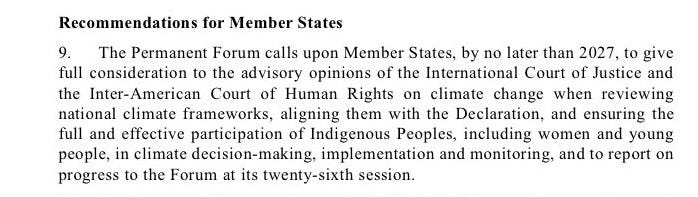
Oh, btw this is the eventual text in the PFII25 report (It establishes that the Forum sees advisory opinions as relevant tools for clarifying State conduct and strengthening implementation of the Declaration, basically contradicting their own objections).
Before you go
The objective failed. I am at peace with that.
Failing is fine. What I cannot afford is failing slow. Staying in the breakdown, replaying the data points, looking for a different outcome in something already over. That is not processing. That is just expensive. It costs you the next move.
The day I stop feeling the anger is the day I should probably stop doing this work. When a recommendation gets managed out of a final report, real people in real territories lose a potential tool. You are supposed to feel that weight. That is not weakness. That is what makes you useful in these rooms.
But the skill is not making the anger disappear. The skill is failing fast and moving. Catching yourself in the Super Bowl breakdown and asking, is this analysis or is this the same dead conversation on repeat? Then closing the tape. Moving to the next thing. Knowing the seed is in the ground, the irons are in the fire, and the train keeps moving.
I still get angry. I just don’t stay there the way I used to.
Here is what I do in the 45 minutes after a loss like this:
Go through your mind and identify what actually happened. Not the emotion. The data points. What shifted, when, in which room. That is the debrief, not the breakdown. Write it down. It closes the loop.
Name the next open swimlane. Not the whole strategy. Just the one thing already in motion. Make it the first call you make.
Kill the replay through replacement. The moment you catch yourself running the dead conversation again, open a draft. A message to an ally. Anything that moves the work one inch forward.
You do not need a multilateral negotiation to use this. You need a loss and a next move. Most people already have the loss. They just have not named the next move yet.
I still fail. I just fail faster now.
How long are you staying angry before you move? And when you move, do you already know where you’re going?
Reply and tell me.
If not, see you next Saturday!
P.S: If this helped, here are 4 ways to go deeper:
Subscribe for free: Get one field note every Saturday on how power actually moves inside UN diplomacy.
Share this with one Indigenous leader: Especially someone who is starting to enter UN spaces, advocacy rooms, or political processes.
Upgrade to paid: Become a team member and get the daily briefings, templates, checklists, and behind-the-room breakdowns I do not publish publicly.
Reply with your question: Tell me what room, process, or challenge you are trying to understand. I may turn it into a future field note.