
The $125 Billion Forest Fund = Super Dangerous
What happens when you decode TFFF's financial architecture from an Indigenous rights perspective.
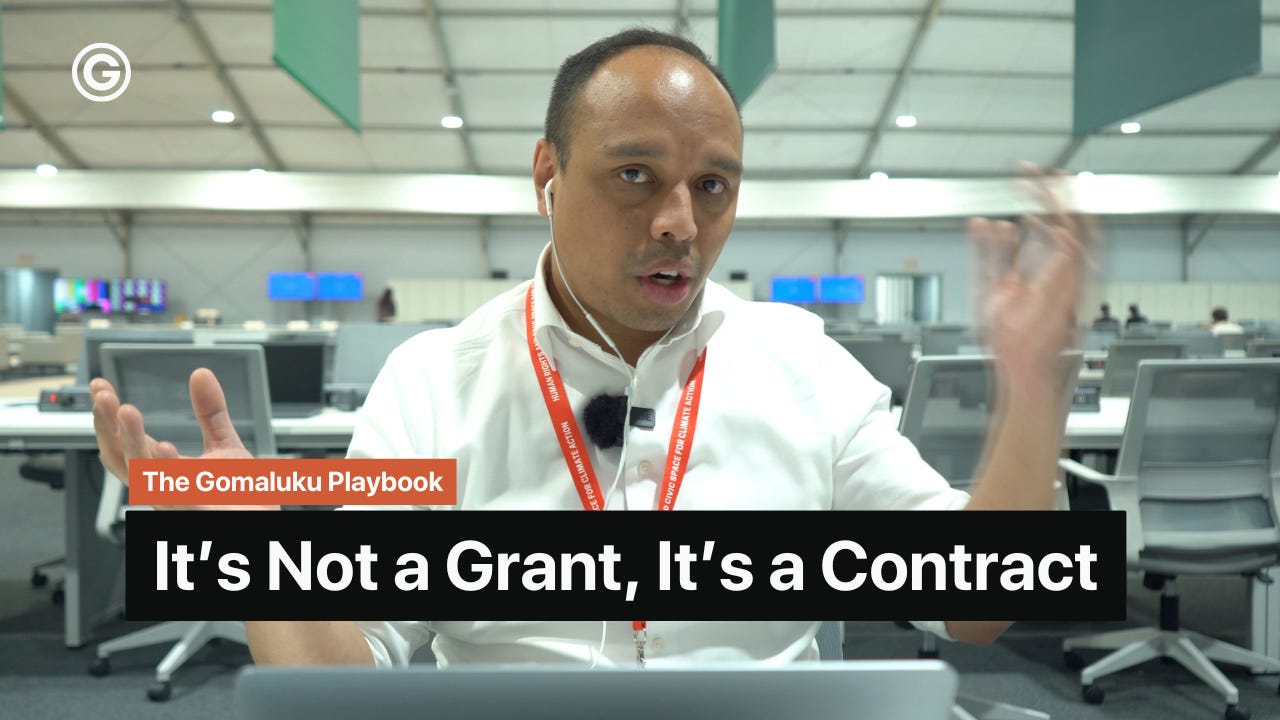
Btw, this edition is going to be a longer than the usual 4 minutes. You’ll see why.
The TFFF was way outside of my pheripherals, until someone on LinkedIn DM’d me asking if I could red team the TFFF from an Indigenous rights perspective as I’ve decoded and critiqued the private finance mechanisms underneath Article 6, NCQG, etc.
So I did, and oh boy, it is more dangerous than it looks.
I know that everyone is excited about the Tropical Forests Forever Facility.
Many Indigenous Peoples too.
Brazil talked about it. The World Bank said yes to host it. People are already repeating the magic line: “Twenty percent for Indigenous Peoples as well as local communities.”
The TFFF uses the phrasing Indigenous Peoples and local communities, but from hereonin you’ll see that I deconflate Indigenous Peoples with others using “as well as”.
It sounds like the thing we have been asking for since the first UN discussions on forests. Money at scale. Recognition of our role. A way to protect forests without begging each year.
But here is the problem. Nobody is really explaining how it works. Nobody is showing where the money comes from. Nobody is honest about the order in which people get paid. So we are about to celebrate a thing that could quietly place us at the bottom of a very large financial machine.
This is why I am writing this. Not to kill TFFF. To make it visible. So Indigenous Peoples can walk into Belém with eyes open. So you can say yes when it is safe. And no when it is not.
I will start with Indigenous rights. That is the easiest door to walk through. Then I will pull in the money. Then I will show you the risks. Then I will suggest to you what to ask for.
I will keep it simple.
Rights First Or We Get Lost
Let us remind ourselves of something basic.
We are Indigenous Peoples. We are not beneficiaries. We are not project implementers. We are not service providers. We are distinct rights holders under international law.
That is what the United Nations Declaration on the Rights of Indigenous Peoples says.
We have the right to our lands and territories.
We have the right to decide what happens there.
We have the right to benefit from the use of our resources.
We have the right to give or withhold consent.
So any new fund or initiative that will touch our territories. Our governance. Our livelihoods. Must live inside that box.
This is the test I want you to hold in your head while you read the rest:
Does it recognise us as distinct from others, e.g. local communities.
Does it let us access money without going through the State.
Does it protect our funding even when the market is bad.
Does it include our right to FPIC at design level.
Does it keep our rights stable.
If the answer to any of these is no. Then the fund is not for us yet. Then it is still a State or investor project. Keep that test close. We will use it a lot.
What TFFF Actually Is
Now let us look at what TFFF says it will do, here is the friendly version people repeat:
TFFF will raise 25 billion dollars from governments and partners.
It will use that to unlock 125 billion. It will invest that money.
It will pay forest countries every year if they keep their forests standing.
20% of that will go to Indigenous Peoples as well as local communities.
Sounds very appealing.
Here is the version without the lipstick:
TFFF is an investment machine, and starts with public money.
It adds private and institutional investors who want safety.
It puts the whole pot into financial markets. It hopes to earn more than it costs.
Then it wants to use that extra money to pay countries that kept deforestation below a target.
Then it wants those countries to pass 20% of what they got to Indigenous Peoples as well as local communities.
That is a very different story. That is not solidarity. That is not reparations. That is not recognition. That is a performance based, State mediated, market funded machine.
The most important line in that paragraph is this: If any part of the chain fails. Indigenous Peoples do not get paid.
If the full 25 billion is not raised.
If private money does not come in.
If interest rates stay high and the portfolio does not make enough.
If the country fails its deforestation target.
If the State decides to hold the money for a year.
We do not get paid. That right there is our first danger.
The Quiet Flip From Grants to Contracts
For twenty years Indigenous Peoples have been asking for direct access to climate and forest finance. We wanted to stop standing in line behind States. We wanted funding for all Indigenous socio-cultural regions. We wanted money that recognises our stewardship.
TFFF speaks our language. It says. Twenty percent for Indigenous Peoples as well as local communities. That sounds like a direct access victory.
Look closer.
This is not a grant that says. Here is your money. You are a rights holder. Use it.
This is a payment that says. You will be paid if your country performed.
This is a payment that says. You will be paid if the investment portfolio performed.
This is a payment that says. You will be paid if the State passes it on.
That is not a grant. That is a contract.
That is pay for services.
Once we accept this category of money at 125 billion scale we will start hearing new sentences from donors and from States. You asked for direct access. You have it now. You wanted recognition. It is in the 20 percent.
No. We wanted direct access to rights based grants. Not to performance based contracts. Those are two different worlds.
This is the second danger. TFFF normalises the wrong world.
The 20 Percent Illusion
Now, let’s talk about the famous 20 percent.
Twenty percent of what.
Of 4 billion a year?
Or of 625 million?
Or of almost nothing?
On stage it will be 4 billion. On paper it will be closer to 625 million once you remove fees. Costs. Conservative investment strategy. Losses. The part that will stay in the facility. On a bad year it can be almost nothing.
20% of 4 billion is 800 million.
20% of 625 million is 125 million.
20% of zero is zero.
So the number we are celebrating depends on a chain of optimistic assumptions.
Full capitalisation.
Strong market returns.
No political blockages.
Countries all hitting their deforestation targets.
I watched Tokyo Drift and while reading TFFF it popped op several times in my head:
But, I have seen enough Article 6 negotiations, and you and me have seen enough climate finance negotiations to know that this TFFF chain never holds perfectly.
So the danger is this: We are being asked to give political blessing today for money that might not materialise tomorrow. And we are being asked to bless it inside a basket that mixes us with local communities.
If we are going to celebrate 20 percent. We need to secure the base first. Otherwise we are celebrating a percentage of a dream.
The Payment Order Tells the Truth
Investment people like to hide the real story in a diagram called a waterfall. It shows who gets paid first and who waits.
Let us strip it to the bones.
The managers and the World Bank get their fees.
The private investors get their return.
The public sponsors recover what they can.
The forest countries get money if there is still water in the waterfall.
Indigenous Peoples as well as local communities get 20 percent of what those countries received.
Read it again: One, we are conflated. And two….we are dead last.
From the finance perspective, in a year when everything is fine. That is not a big problem. In a year when the markets are weak. Or when one big forest country fails the target. Or when the board decides to keep more money inside the facility to protect the rating. We are the ones who feel it first.
This is not a technical detail. This is a hierarchy.
Finance first. States second. Indigenous Peoples in the back of the bus.
That is the third danger. A rights based fund would pay rights holders even in bad years. A performance based investment facility will not.
Volatility As a Form Of Control
Why is this hierarchy so dangerous.
Because volatility travels from the top to the bottom. And control travels with it.
If Indigenous Peoples’ income arrives every year no matter what. We can plan. We can say no to bad projects. We can pay our negotiators. We can fund our own consultations. We can resist political pressure.
If our income goes up and down because the market went up and down. Then someone can always say. This year was weak so we need more conditions. Or. This year was weak so we need to let more actors into the 20 percent bucket. Or. This year was weak so payments will happen through government systems.
Volatility becomes a way to keep us in line.
You can test this easily. Ask yourself. Who benefits from a model where our money is flexible while our obligations are fixed. Not us.
A good sentence to teach people: Rights should not follow the market.
Where TFFF Collides With UNDRIP
Now that we have seen the inside. Let us test it against the rights baseline we set at the start.
Distinct status: TFFF places us in a joint basket with local communities. We have been fighting exactly this conflation in the Human Rights Council because it dilutes Indigenous Peoples. TFFF tries to introduce it again. This time with a bigger number on it.
Direct access: TFFF money goes to States first. Then maybe to us. It is the same model that delayed REDD money to communities for more than a decade. We are going backward.
Control over territories: TFFF can deny payment to a community that kept zero deforestation. Simply because the rest of the country failed. That is collective punishment. It is not consistent with the Indigenous Peoples’ right to self-determination.
FPIC: TFFF is being designed and announced before a proper consultation with Indigenous Peoples on its financial architecture. That means the Free Prior and Informed Consent is missing at the design level. Adding an advisory council later does not fix that.
Benefit sharing: TFFF shares what is left after investors and managers have been paid. That is benefit sharing in reverse.
Four misses out of five. That is not a small tweak. That is a structural problem.
Why LDF is Actually Safer
A lot of people will try to sell TFFF next to the Loss and Damage Fund.
It makes sense politically.
Both are hosted at the World Bank for now.
Both were won by the global South.
Both talk about justice.
But the engines are different.
The Loss and Damage Fund is pay in. Pay out. If donors put money in. It can pay. It is slow. It is underfunded. It is political. But it is legible. You can see the money.
TFFF is invest. Perform. Pay if everything worked. It is ambitious. It is fast. It is glossy. But it is opaque.
LDF has adequacy risk. It may not have enough. TFFF has adequacy risk. Plus market risk. Plus gatekeeping risk. Plus category mixing risk.
Four risks are worse than one.
So if someone says. This is like LDF but for forests. You can answer.
No. LDF pays when the sky falls.
TFFF pays when the market smiles.
Huge caveat: I was in the LDF negotiations for the IIPFCC and am not advertising LDF as good, it has major flaws.
The Political Trojan Horse
Every COP President wants to create a legacy. Dubai has the LDF, Azerbaijan has Article 6 & NCQG and Belém too will want something big. Brazil will want to show leadership. Many governments in the South will want to show that they created a fund instead of waiting for the North.
So TFFF will arrive in rooms with a lot of political momentum.
That is exactly why it is dangerous.
Because once a thing is celebrated as historic. It is hard to fix it later. Anyone who tries to fix it will be accused of undermining South South solidarity. Or of not supporting forest countries. Or of getting in the way of a large scale solution.
So we have to name it now.
TFFF looks like recognition. It contains contracts.
TFFF looks like a grant. It contains performance penalties.
TFFF looks like Indigenous friendly finance. It conflates us with local communities.
That is a Trojan Horse.
If we let it pass. The same model will show up in Amazon Fund 2.0. It will show up in updated Green Climate Fund windows. It will even show up in biodiversity mechanisms like the Cali Fund. We will start seeing. Twenty percent for IP&lc. Paid after national targets. Paid after investment returns. Paid with advisory seats instead of voting seats.
That is not the future we want.
Another deconflation thing: Many use IPLC as a common acronym for Indigenous Peoples as well as local communities as a monlith, even in the acronym you can start using “IP&lc”. Its a start to deconflate.
What You Should Ask For
So what do we do. We do not just say no. We show the clean version.
Start from UNDRIP: Indigenous Peoples have a separate window. Not mixed. Not conditional on national performance. Not treated as beneficiaries.
Capitalise it at source: Put real money in that window from the 25 billion. Do not wait for investment returns. Do not make Indigenous income follow the market.
Make it grant based: This window pays grants to Indigenous Peoples and their institutions. Not service contracts. Not pay for performance. Not year to year haggling.
Add monitoring for transparency: We are not asking for a blank cheque. We are asking for stable money with clear reporting. We can do MRV for our territories. We can show that our forests are standing.
Give Indigenous Peoples a vote: Advisory councils look nice. They do not move money. We need real seats in the body that approves rules and payouts.
Only then add the national performance part: States can have their performance based forest payments. That is fine. Just do not put us under it.
That is TFFF 2.0. It still lets Brazil say this was a historic initiative. It still lets the Bank say this is well governed. It still lets investors say their money is safe. But it puts Indigenous Peoples back in the rights place.
Why This Matters Beyond Belém
This is not only about one facility.
If we let this financial logic in. It will travel.
It will travel to CBD.
It will travel to the BBNJ.
It will travel to the UNCCD.
It will travel to national climate funds.
It will travel to carbon markets.
People will say. Indigenous Peoples accepted performance based funding in TFFF. So we will apply the same logic here.
That is why we need to hold the line now. While the design is still fluid. While the documents are still being written. While people still need our voice to sell this as inclusive.
The Simple Idea to Remember
If you forget everything else. Remember this.
A fund that can cut our money because someone else failed is not a rights fund.
Say it to your community.
Say it to your caucus.
Say it to the Bank.
Say it to Brazil.
A fund that puts Indigenous Peoples last in the payment order is not a historic victory.
Say it until people hear it in their sleep.
A fund that mixes Indigenous Peoples with others at global scale is not alignment with UNDRIP.
Say it even when they show you the big number.
Because once that idea sits in people’s minds. The rest becomes inevitable.
They will have to show the waterfall.
They will have to show the stress tests.
They will have to create a separate Indigenous window.
They will have to make part of the money grant based.
They will have to do FPIC properly.
That is how we make the whole product visible.
Before You Go
We are in a season where big climate and nature finance facilities are being created faster than our movements can digest them. Loss and Damage Fund. Cali Fund. Now TFFF. All of them say the right words. All of them want to show that Indigenous Peoples are included.
In that kind of season. Our job is not to clap first. Our job is to read first. Decode first. Ask first. Only then endorse.
TFFF can become something powerful. But not like this.
Not with volatility on top and Indigenous Peoples at the bottom.
Not with our rights tied to national performance we do not control.
Not with our status diluted in an IP&lc basket.
Not with advisory seats instead of real power.
Start with rights.
Then build the money around it.
That is the order.
If we keep that order. We win.
If we forget that order?
We become service contractors in a 125 billion dollar facility that will pay us last.